
Wheels and plastics
Why Tyres Turn Brown
3 minEstimated reading time — roughly how many minutes it takes to read at a normal screen pace.
Brown streaks on tyre sidewalls aren't dirt or a flaw in the rubber — they're a natural process called blooming. We explain what triggers it, why it shows up sooner on a daily driver, and when it's more than just appearance.
On this page
On this page6
Brown streaks and patches on tyre sidewalls – it looks like dirt that won't wash off, or a flaw in the rubber. Usually it is neither.
We'll show you how to tell what it is on your car, why it appears sooner on a car that's driven than on one that sits in a garage, what we do about it here at the studio – and what can be done on top of that, if brown sidewalls bother you between washes as well.
When the sidewall is brown even on a freshly washed car
A protective additive is mixed into the rubber during manufacture. Without it, the sidewall would crack over time out in the air and sunlight.
That additive doesn't stay put in the rubber. It slowly works its way from the inside out, and at the surface, where it meets the air, it turns brown. So that brown film on the sidewalls is the protection itself – it has travelled up from deep in the rubber to where you can see it.
It isn't a fault in the tyre, and it isn't dirt from outside. The trade calls it blooming: the additive literally blooms out of the rubber onto the surface. You can follow that journey from deep inside to the surface in the demo.
Interactive simulation
Antiozonant blooming and rubber aging
Use the slider to set months and switch profile. Daily driver accelerates blooming via centrifugal force and heat; a garaged car is significantly slower.
Blooming onset
BloomingAntiozonants migrate to the surface via centrifugal force and heat, then oxidize → matte brownish tint. Standard aging stage, correctable with cleaning + dressing.
As long as there's enough of the additive left inside, this really is only a change of colour. What happens once the supply runs out, we describe below.
How to tell it apart from dirt
You can tell the difference by the way it comes back. Dirt washes off and reappears only when you get the car dirty again; the brown cast from the rubber comes back on its own, even with the car standing clean in a garage.
The second clue is how it looks: this isn't a dark deposit you can scrape off with a fingernail, but a matt brown film that seems to rise out of the rubber.
You don't have to work this out on your own. When we hand wash a car, we look the sidewalls over and tell you what's on them.
Why it shows up sooner on one car than another
Browning is sped up by heat – the sun, hot asphalt, heat off the brakes. And by driving itself: a turning wheel pushes the protective additive towards the surface faster than standing in a garage does.
That's why it shows most on cars that cover a lot of miles and brake hard. On a car in daily use, visible browning tends to show after 6 to 9 months; on a garaged car, the same thing appears only after a year or more.
So a car in daily use browns roughly two to three times faster. None of this means there's anything wrong with it.
When hairline cracks appear on the sidewall, it's no longer about looks
On a car that's on the road every day, the supply of the protective additive runs out after a year or more, and the rubber at the surface is left unprotected.
A fine network of hairline cracks then appears on the sidewall. The rubber turns brittle and handles load less well, especially at higher temperatures.
At that point it's no longer cosmetic, but a condition worth having looked at. That's something we check during a wash, and we tell you what we found on the sidewalls.
What we do about it during a wash
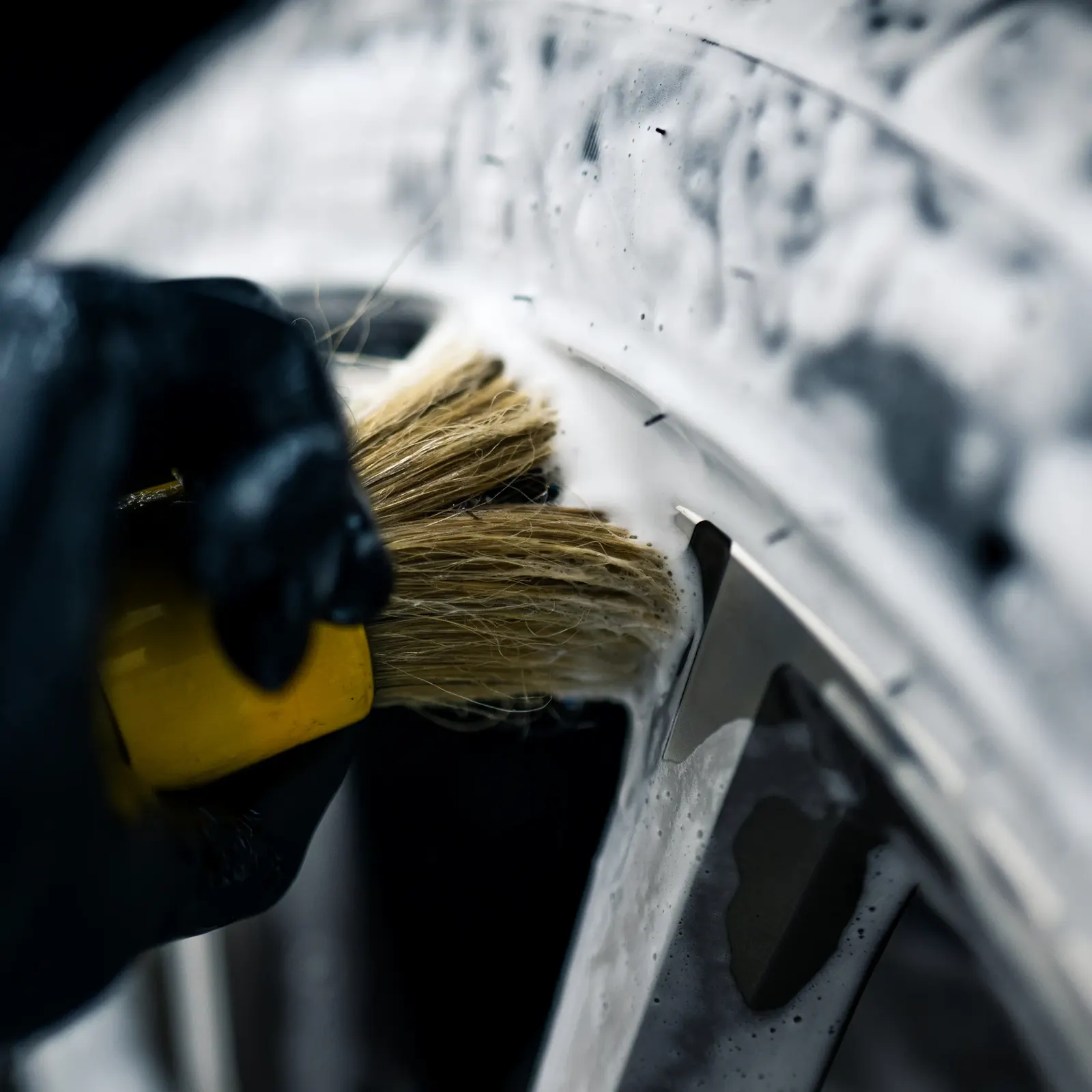
During a hand wash we clean the sidewalls with a solvent-free, silicone-free cleaner, take the brown film off the surface, and then treat the rubber with a water-based rubber dressing.
After a wash like that the sidewalls are clean and matt black – but only for a while. The additive keeps working its way out, so on a car that's driven every day the brown cast is back within a few weeks. A wash slows the browning down and evens the surface out; it can't stop it. If you want black sidewalls between washes as well, that takes an extra step – which is what the last part is about.
While we wash, we also look the sidewalls over, and if we find hairline cracks, we tell you and recommend what to do next.
When you want black sidewalls between washes
It comes down to what goes on the rubber after the wash.
An ordinary glossy solvent-based dressing shows this up well. It looks good in the car park, but after the first drive you'll find it spattered across the paint behind the wheels, and within a few weeks the sidewalls are grey again and still browning. Products with solvents and silicone speed the browning up; water-based products slow it down.
So on cars where black sidewalls matter, we use the Tyres add-on of ceramic surface protection – a water-based polymer treatment. It stays where it's put, doesn't run onto the paint and doesn't attract dust.
You don't need it. If you're happy with sidewalls that are clean and matt black after a wash, you're done – and you've slowed the browning down anyway. The add-on is for anyone bothered that a fortnight later it looks much as it did before.
Don't want to wait for an appointment? Send us a photo of the sidewall – from that we can tell whether it's ordinary blooming, or whether the tyre is worth a closer look. Or bring the car in and we'll look at it.
We take care of tyres and wheels as part of hand washing.
Topic: Wheels and plastics
More in this topic