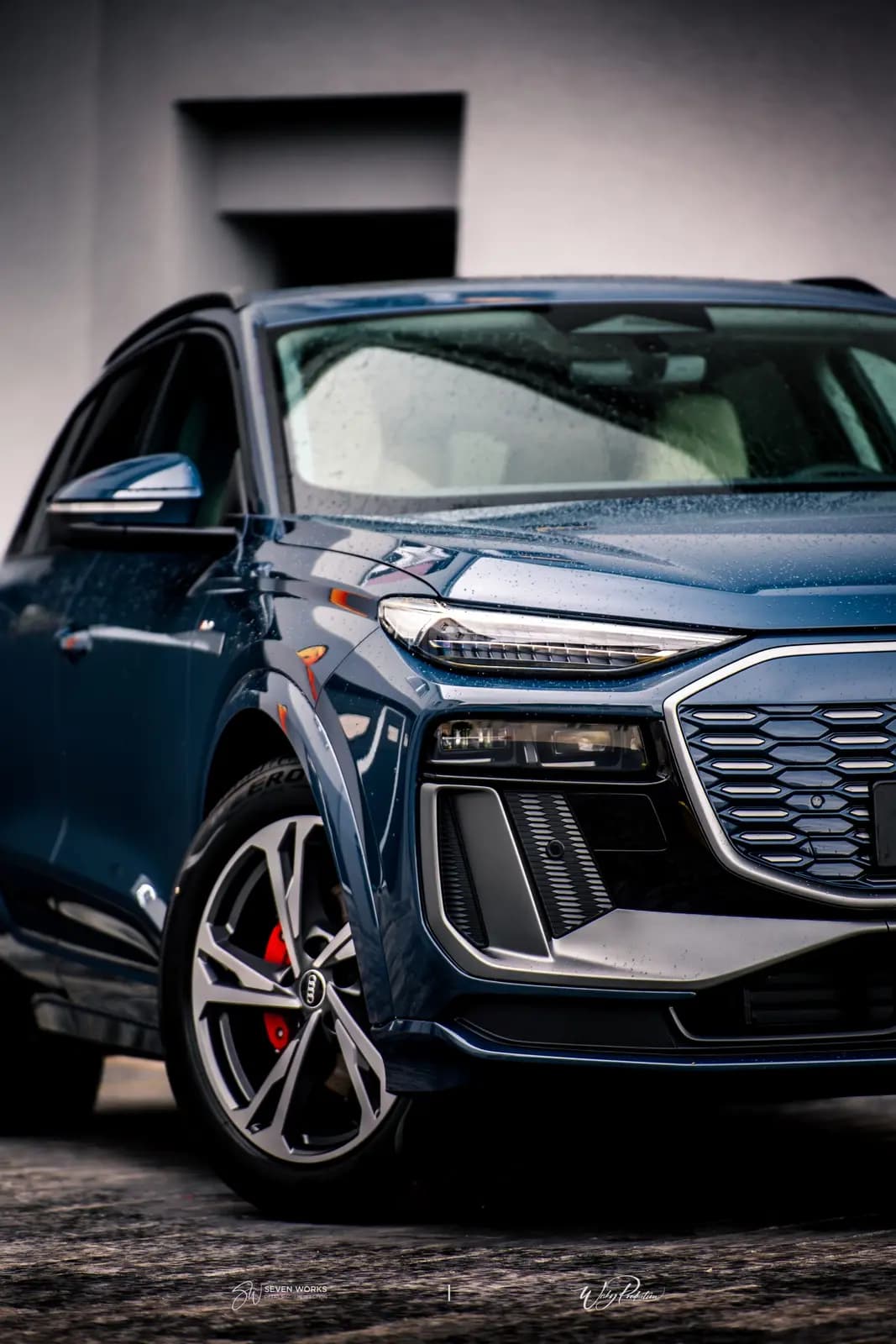
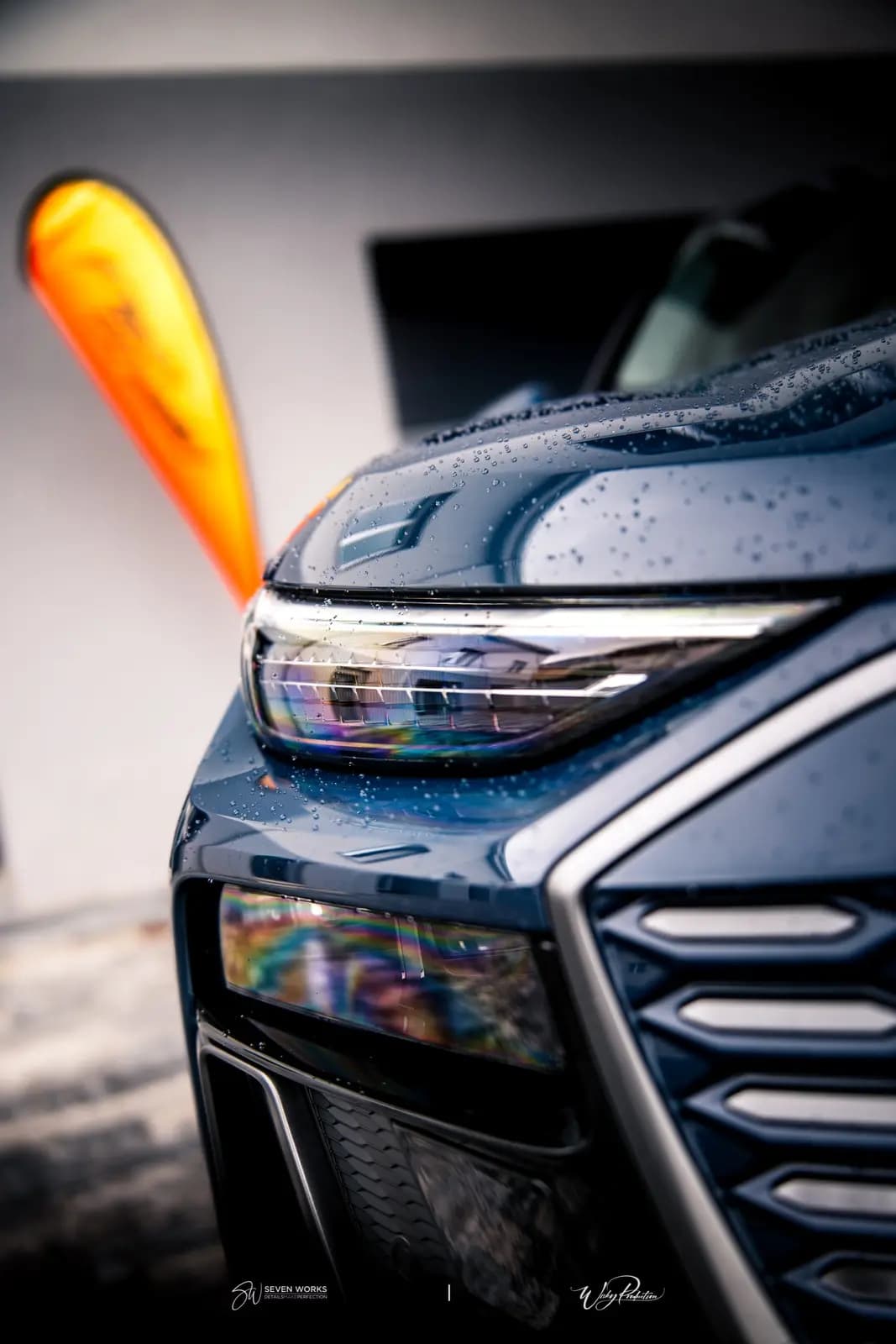
The car is freshly washed, and it still doesn't look like the day you picked it up. Water spreads across the bonnet instead of beading up. Water spots stay after rain, and dirt only lets go on the second pass when washing. Without protection, shine only lasts until the next wash.
Ceramic coating is a thin layer that bonds with the paint and won't wash off with shampoo or rain. Water beads and runs off it, dirt sticks to it less, and washing goes faster. We can also apply it over PPF film, so wrapped and unwrapped parts of the car wash just as easily. We offer seven FEYNLAB lines depending on what you expect from the car. You don't have to choose on your own, though: just tell us how you use the car, and we'll recommend one line.
Which protection your car needs
The years quoted for each line are the manufacturer's figures — that is how long FEYNLAB says the layer should hold. How much of it a car really gets depends on use: where it parks, how far it runs and what it is washed with. The article How long ceramic coating actually lasts goes into this in detail.
- For one year, or if you're starting out with ceramic: FEYNLAB The Original Ceramic. Protects for a year and also suits a car you'll be trading in soon.
- For three years, if shine matters most to you: FEYNLAB Ceramic by Paul Dalton. The line was developed with detailer Paul Dalton, and the manufacturer built it around gloss and a smooth, slick surface.
- For three years, with a thick layer that's easier to wash: FEYNLAB Ceramic V3. A layer with a high solids content. The manufacturer states it's self-cleaning.
- For five years, even on a car that drives all winter on salted roads: FEYNLAB Ultra V3. According to the manufacturer, its strongest layer with high chemical resistance.
- Against fine swirl marks from washing, mainly on dark paint: FEYNLAB Heal Lite. A self-healing layer where light swirl marks from washing even out when warmed by the sun. According to the manufacturer, it heals less than Self Heal Plus.
- Full self-healing: FEYNLAB Self Heal Plus. A multi-layer system for which the manufacturer states full self-healing ability.
- For matte or satin paint: FEYNLAB Matte Ceramic. A regular ceramic would turn matte paint semi-gloss. This layer keeps it matte, and water will still run off it.
The manufacturer supplies Ultra V3 only to certified installation centres, and Self Heal Plus only to its partners. SEVEN Works is a certified FEYNLAB studio and installer, so you can get both lines here.
What sets the variants apart for you
First decide how long you'll keep the car: one, three or five years. Then choose based on what's bothering you about the paint.
Regular lines form a hard layer. Fine marring from washing and driving then happens on that layer, not on the paint. The self-healing lines, Heal Lite and Self Heal Plus, are softer, but fine swirl marks that form in them from washing even out with heat. The surface needs sunlight to warm up for that. In winter the effect barely works, and swirl marks stay visible until it warms up.
In practice: if you wash the car yourself and every fine mark on dark paint bothers you, you'll lean toward a self-healing line. If you drive a lot, park outside and want peace of mind for several years, you'll lean toward Ceramic V3 or Ultra V3.
What the price depends on
The price depends on the car's size, the line and length of protection you choose, and how much work the particular car needs. Work is what varies most. A car washed every two weeks needs little preparation. A car last washed several months ago needs more chemicals and hand work. A multi-layer line, such as Self Heal Plus, takes more time, because each layer needs to cure.
What you're paying for
Applying the coating itself is the shorter part of the job. Most of the time goes into preparation, because ceramic only bonds to clean paint. On leftover dirt, wax or polish residue, it only catches in patches and disappears from those patches within a few months.
- Paint inspection. Before we start, we'll show you what will wash off and what's a defect the coating won't hide. If you want to know the paint's condition in detail before booking, you can order Paint Diagnostics separately. If you follow up with protection, the diagnostic price is deducted from the job's price.
- Washing. Everything loose comes off the paint.
- Chemical decontamination. What washing didn't remove comes off next: brake dust bonded into the paint, tar, insect residue and mineral spots from hard water.
- Hand cleaning. Particles bonded so firmly into the paint that chemicals won't dissolve them are removed by hand.
- Removing old layers and degreasing. Old waxes, polishes and fillers have to go, so the coating bonds with the paint, not with them.
- Correction, only where needed. Protection would seal in swirl marks and scratches underneath it. On an older car, we correct the paint first and only then apply protection. We'll propose light paint enhancement or paint correction beforehand as a separate step with its own price.
- Applying the chosen FEYNLAB line. In one or more layers depending on the line, with time to cure.
- Handover. By your car, we'll show you how to wash it, what to wash it with, and how to handle the microfiber wash mitt.
If something goes wrong
We give a two-year warranty on the work itself. The material carries FEYNLAB's manufacturer warranty under its terms. We check the coating's condition at warranty checkups. If something looks off to you between checkups, bring the car in and we'll take a look together.
What protection won't fix
Ceramic protects paint from chemicals, salt and sun, not from flying stone chips. PPF film belongs on the front bumper, bonnet edge and mirrors. We can then apply ceramic over the film too. How to split the two protections is covered under combining protections. Defects the paint already has stay visible under protection. Only correction before application can even them out. If shine and easier washing for a shorter period is what you're after, basic surface protection is enough.
What to do with the coating afterward
After handover, the layer is still curing. For the first two nights, the car should sit under cover, out of rain and dust, and wait a week before the first wash. After that, wash it by hand using the two-bucket method, a neutral shampoo without wax, and skip machine washes with brushes. The full process is covered in After picking up your car with ceramic coating. If you'd rather not wash the car yourself, you can book car wash for ceramic or film protection with us.
Once water stops beading on the paint, bring the car in. Ceramic can be renewed, and our customers come back to us for renewal. When renewal is due, we'll judge from the condition of the layer on your paint.
Ceramic Coating Add-Ons
While the car is with us for other work, we can add these extras to it. They can't be booked on their own, only applied along with another job:
- Wheels and calipers. A ceramic layer on the rims and brake calipers.
- Tyres. A dressing for the tyre sidewall.
- Interior ceramic. Ceramic protection for surfaces inside the car.
- Plastic trim. Ceramic protection for the exterior plastic trim.
- Ceramic on film. A ceramic layer over PPF film.
- Top coat. An extra layer on top of ceramic protection already applied.
Request ceramic protection
Tell us the make and model, paint colour, how long you plan to keep the car, how often you wash it and where it's parked. If the car has PPF film, mention that too. A photo of the bonnet and sills in daylight helps. Not sure which line to choose? Just tell us what's bothering you about the paint, and our studio in Ústí nad Labem will recommend one.