
Layers and limits
When Paint Sticks: Why Some Cars Need More Time
4 minEstimated reading time — roughly how many minutes it takes to read at a normal screen pace.
On some cars, the polishing pad stops gliding and starts grabbing instead, leaving fresh swirl marks that weren't there before. We explain why that happens, and how to spot paint that reacts this way before you start correcting it.
On this page
On this page8
After polishing, the bonnet looks worse than it did before. Dull smears, hazing, and in strong light new swirl marks where there were none. The longer the polishing went on, the more of them there are — the defects are not going away, they are multiplying.
People come to us with this after having their paint polished elsewhere, and after trying it themselves at home. They ask the same thing: whether it can still be put right, and whether it is worth putting more money into the car.
Usually it can be put right. The fault is generally not in the hand holding the machine, nor in the machine — it is in the condition of the paint. In our workshop we call paint like this sticky paint, and it cannot be polished until it has been prepared for it. We will show you what gets it into that state, why polishing turns against you on it, how to recognise it on your own car, and what we do about it.
Why your paint dried out
Your car has spent years in the sun, in the rain and without anyone renewing its protection. Once the protection was gone, the sun bore straight down on the glossy top layer of the paint, the one you touch. It then oxidises and loses its smoothness.
What you are left with is a finely porous surface: a network of open cavities that the paint did not have when it was new. A polishing pad will not glide across it, though — it grips and drags. Hence sticky paint, even though it feels dry to the touch.
For your car this is not damage yet — the paint has not gone anywhere, it is only missing the layer that polishing glides on. But paint like this must not be polished until we have filled those cavities. We do that for you; we say below what with.
You will see it first on the bonnet and the roof — they take the most sun and reach this state before the doors and wings do. On dark paint with no renewed protection, expect it after 6 to 8 years in the sun. What decides it is how long the car went without protection, not the year of manufacture — with a neglected two-year-old car you are worse off than with one that someone looks after.
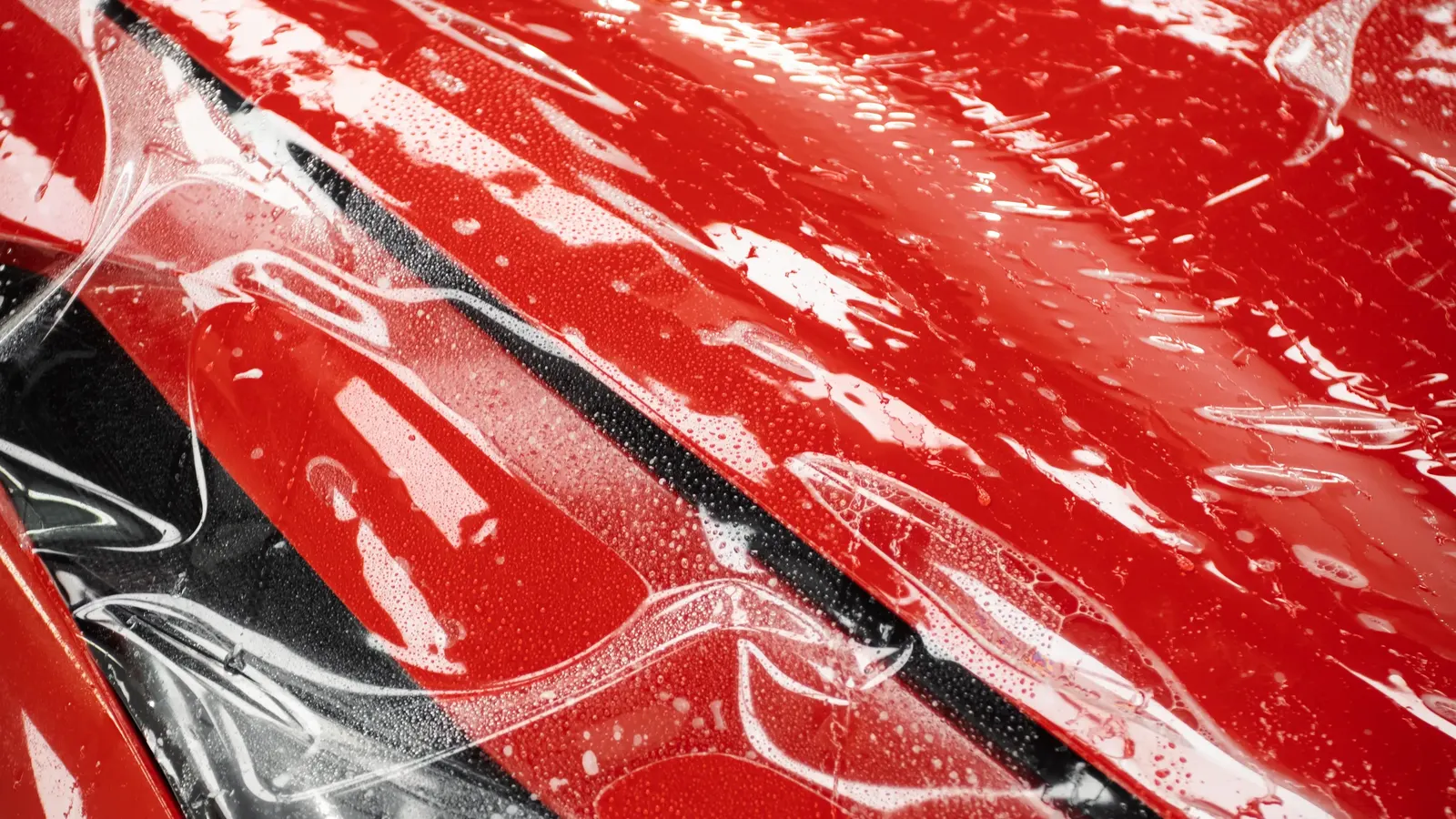
Why the defects keep multiplying as you polish
When we correct your paint we work with a polish that has two parts: a liquid one that lubricates and fine abrasive particles that cut. As long as the paint is healthy, both of them glide across it together.
On dried-out paint you lose the lubrication straight away — the paint soaks it up the way a sponge soaks up water. You are left with dry abrasive on the surface with nothing to slide on, and under your hand you feel the pad stop running smoothly and start to bounce; this is known as pad hopping.
From that moment on you are drawing a dense network of fine scratches into the paint: up close you see them as smears and swirl marks, from a distance as a dull haze. Those you will not polish out — every further pass ends the same way as the one before it. That is why your defects keep increasing instead of decreasing.
If this is what your car is going through right now, it is worth stopping straight away: every further minute adds scratches that we then have to polish out, and that thins the paint more than it needed to be.
When you pressed harder, added speed and more polish
These three reactions suggest themselves first, and not one of them helps. Pressure adds friction where there is already too much of it; higher speed evaporates even the lubricant still left in the pores; and more polish only supplies lubricant that soaks in exactly as the last lot did.
If you tried this on your own car and it got worse, you have a fairly reliable sign: this is how dried-out paint behaves.
What you can see before a machine touches the paint
You do not have to wait for polishing to reveal the condition of the paint. It is enough to run your hand over the cooled bonnet and pour a little water onto it.
Dried-out paint looks dull and drags under your hand. Water spreads across it into a flat patch and stays there, instead of gathering into beads and running off.
Behind that difference is surface energy: a layer of protection keeps it low, so water has nothing to hold on to and pulls itself into beads. As the paint ages and oxidises, the energy rises and the drop spreads out. So a spreading drop does not by itself mean the paint is dried out — it means nothing is holding on it. And that is exactly the state dried-out paint comes from.
When a proper wash is all the paint needs
Not every paint that fights back during polishing is dried out. A film of dust, tar residue or old wax clings to the surface just as unpleasantly and feels almost the same under your hand.
A proper wash and degrease shows the difference. If the problem went away with the dirt, it was surface contamination and a decontamination wash deals with it. Correction can then begin straight away.
If the paint behaves the same way after washing, it is dried out and washing will not fix it.
What we do with paint like this
First we look at it and tell you what condition it is in; we assess this as part of paint diagnostics. What you have seen on the car yourself helps us here — write and tell us.
Dried-out paint can be prepared for correction; it is not the end of the road. We saturate it with a polymer primer: it soaks into those cavities and, unlike water, does not evaporate out of them, so they stay filled and the pad has something to glide on again. We use FEYNLAB Ceramic Primer; as a certified studio we have access to it.
Only then do we decide how far to go. Sometimes paint like this will take a full correction; other times we recommend a gentler approach, so that the thinned layer is not cut into any deeper.
So that it does not return to the same state
If no protection follows the correction, the paint starts drying out again — this time from a freshly cut surface.
That is why we install ceramic surface protection on the finished paint straight away. And the water test will tell you at any time whether the protection is still holding: as long as water gathers into beads and runs off, all is well.
What to write and tell us about the car
Write and tell us what car it is and what you have already tried, and add a photo of the bonnet in strong light — this condition shows up well on one. We will tell you whether it is sticky paint and what is worth doing about it next.
Topic: Layers and limits
More in this topic