
Film on the paint
What PPF actually does for your paint
3 minEstimated reading time — roughly how many minutes it takes to read at a normal screen pace.
Light specks of chipped paint on the bonnet and front bumper, thin scratches around the door handle, a scuffed spot on the sill from a kerb. Those marks go into the PPF film instead of the paint. We'll show what it stops and where its limits are.
On this page
On this page5
On the bonnet and the front bumper, after a few tens of thousands of kilometres, small light specks appear – the places where a stone chipped the paint. Around the door handle, thin scratches build up; along the sill edge, a scuffed patch from a kerb. This is what ordinary driving does to a car, not careless driving.
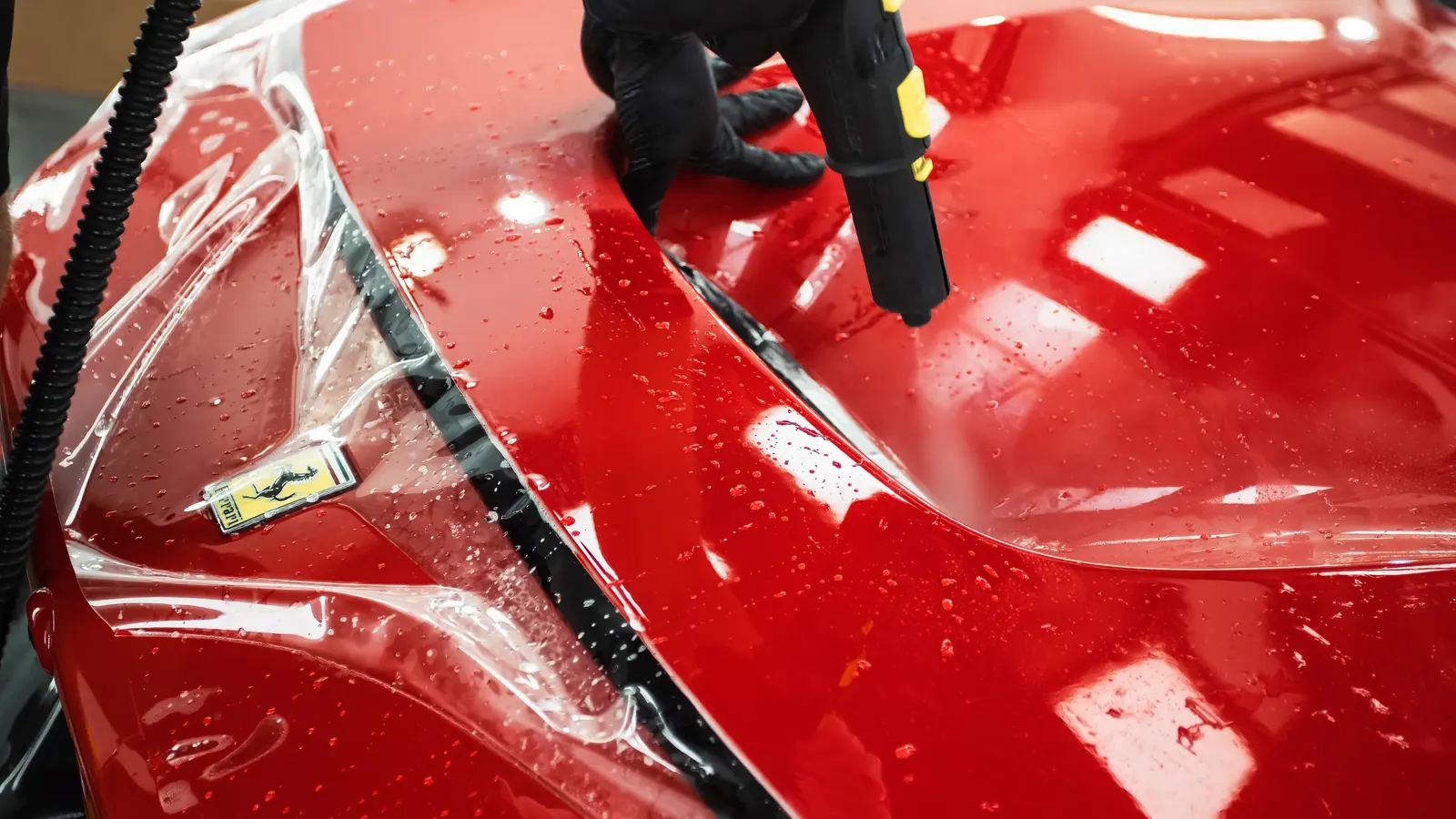
PPF, short for paint protection film, is a transparent layer we apply directly onto the paint. What would otherwise be imprinted into the paint is imprinted into the film. The film doesn't improve the paint – it carries the load of everyday driving in its place. The paint underneath stays in the state the installation finds it in, and the scope is decided by where on the car that load falls.
What happens to a stone that would otherwise hit the paint
A stone from the motorway, a scuff from a car park, a small knock against a kerb – they come just as often after installation as before; what changes is where they end up. They stop at the film before they reach the paint: the risk hasn't gone away, it has moved to a material built to take it.
The film takes more because it is flexible – it absorbs a small impact instead of leaving a chipped speck. And it is made for a car that gets driven and washed: small mistakes during washing and everyday contact with the surroundings stop at it.
A scratch that closes in the warmth
Small scratches on the film smooth themselves out to a degree with heat – this is called the self-healing effect. The demo shows how a scratch fades as the heat rises:
Interactive diagram
Self-healing — simplified model
Posuvník simuluje dodanou energii (např. teplota, IR ve studiu). Skutečný výkon závisí na produktové řadě, tloušťce vrstvy a typu defektu.
Resting state
Micro-scratches may be visible — the polymer matrix is still more rigid at this stage.
Line = micro-scratch (simplified)
That tolerance isn't unlimited, though. A deep gouge that goes through the film won't close on its own and reaches the paint beneath it.
When you expect better paint and a car without worries
The film on its own doesn't improve the paint: it doesn't refine its texture and it doesn't fix what is already on the surface. You can tell how the car will look after installation before we lay the film down – look at the paint in hard light. What you see on it today, you will see under the film too. Gloss belongs to the top layer: it doesn't hide unevenness underneath, and a glossier film tends to bring it out in hard light.
Uneven paint is preserved under the film for years. If what you mainly want is for the paint to look better, paint correction comes first – so we look the car over and tell you what would stay visible under the film. On a new car that is no reason to put the film off for months: the inspection and any correction take a few days, while every speck that lands before then stays under the film.
Installation doesn't make a car maintenance-free. Day to day you don't have to treat it more carefully, but the care doesn't change: the film is a surface like any other, and neglected washing shows on it just as it does on paint. How the surface behaves when washed and how quickly dirt takes hold on it again, the film doesn't change – for that we add ceramic coating to PPF on the rest of the surface.
What you see after several years of driving
After years, the wear is on the film, not on the paint underneath. It ages differently from paint – it doesn't go matt from the sun across the whole area; instead small defects build up that the self-healing effect no longer closes.
When that comes depends on how many kilometres the car covers and where; you read it from the car, not from the calendar. Once the film is more visible on the car than the paint under it, we replace it, and the paint comes out from underneath as it went in. That is why the film is installed: the value of the original paint stays with the car over the years.
When you're deciding how much of the car to cover
The front – the bonnet and the bumper – takes stone chips on almost every car. A scuffed sill edge and scratches by the handle build up according to where you park.
If the car spends most of its time in a garage and what matters to you is appearance rather than impacts from the road, ceramic coating on its own will do. We then install film only where the car's use will actually make use of it – we describe how the two technologies work together in When combining technologies makes sense.
How much of the car goes under film follows from how you drive it and what you see on the paint today.
You'll find an overview of the protection options in the Guide.
Topic: Film on the paint
More in this topic