
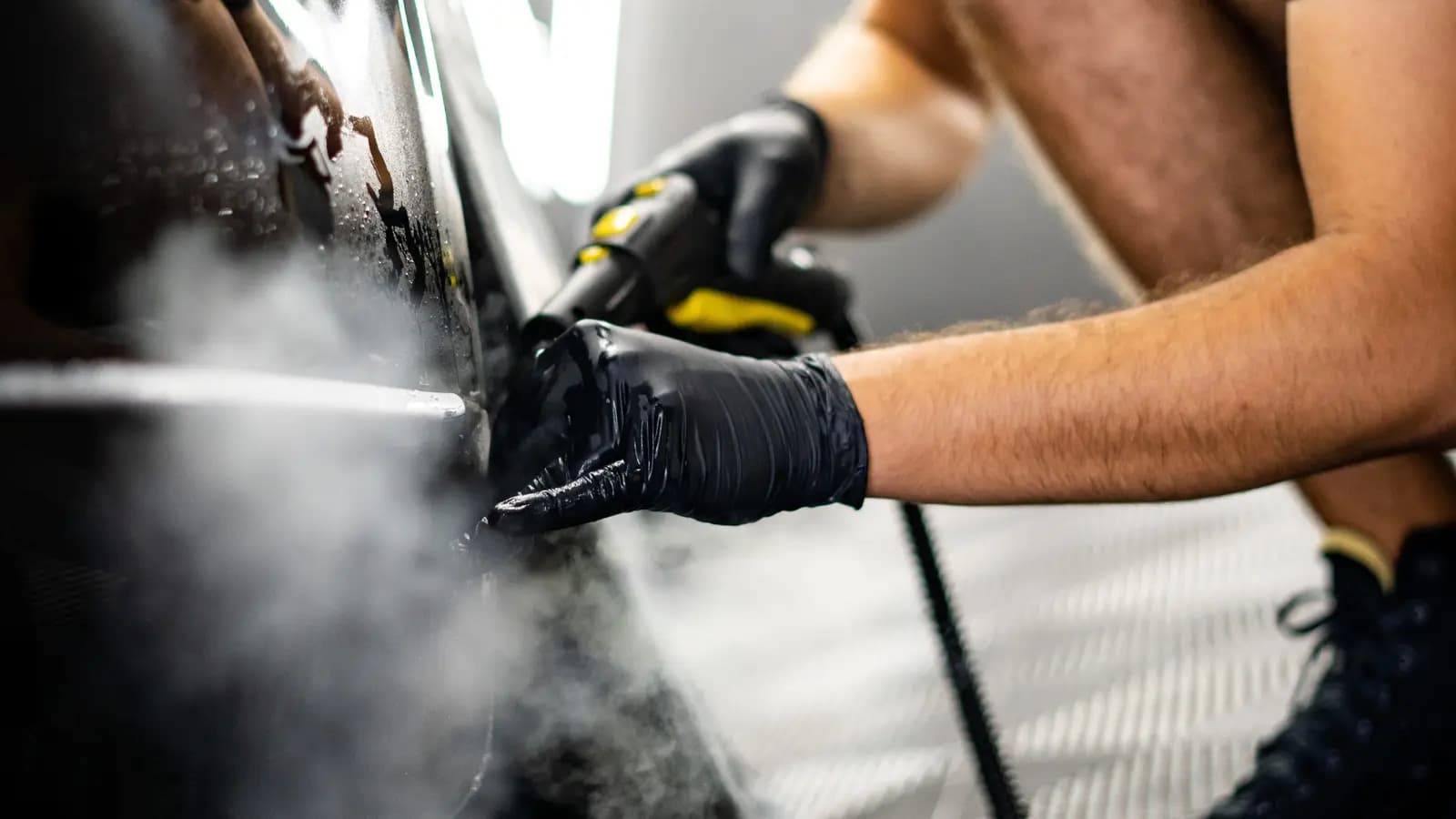
The car is freshly washed and looks clean from a distance. But run your fingertips over the bonnet and the paint drags like fine sandpaper. On lighter paint you'll see tiny rust-coloured dots and black specks, white rings of dried water on the roof that even a dry cloth won't wipe off, and orange dots on the wheels that don't disappear even after a third wash. It isn't that you're washing the car wrong. These contaminants bite into the paint, and ordinary shampoo just flows around them.
Thorough wash with residue removal is for you if this is what you see or feel on the car. If what bothers you is more grey seams and dirt in the bodywork details, and the paint is smooth to the touch, one level down is enough: detailed exterior wash. If the paint stays dull even after decontamination and fine hairline marks show in the sun, that's a job for light paint enhancement, one level up. If you're not sure what you're actually seeing on the paint, start with paint diagnostics instead.
Where it comes from
The rust-coloured dots are iron particles from the brakes, the black specks are tar from the road. Park under trees and resin builds up; after winter and after the sprinklers, whitish mineral deposits from hard water appear. The longer they sit on the paint, the more firmly they hold on. More on this in the article Paint Decontamination at Home, or in a Studio.
What you're paying for
- Rinse and wash. First we rinse off the loose dirt, so sand doesn't get rubbed into the paint, and then wash the car in contact with the paint.
- Iron and tar chemistry. The product is left to work and then rinsed off. The rust-coloured dots turn purple as it acts, so you can see where the worst of it sits.
- Wheels according to what's on them. Iron from the brakes needs a different product than white water spots. We choose the chemistry based on the wheel's finish. Why it matters is covered in the article Cleaning Wheels Without the Risk.
- Mechanical paint cleaning. What the chemistry doesn't dissolve, we lift off the paint with clay and lubricant, until the surface glides smoothly. Most of the work is usually in the places that are hard to reach at home: the sills, the areas behind the wheels, and the rear.
- Degreasing. We clear the paint of residue, so the next layer can bond to a clean surface.
- Inspection under light. We go over the paint under a strong light. It's done when it glides evenly across the whole car and no marks remain under the light.
You get clean paint, and with it an answer to what you saw on the car was just contamination, and what is a defect in the paint itself. Washing and surface preparation here is done by Daniel Kumšta.
What the price depends on
The main factor is how long it's been since the car last had a proper wash. Fresh tar comes off with less chemistry and in less time than tar that's been baking into the paint since spring. Beyond that it depends on the size of the car, how much buildup is on the paint and wheels, and how much manual work is left after the chemistry has done its part. We'll tell you the exact price based on the actual condition of the surface.
What decontamination doesn't fix
Decontamination deals with what's sitting on the paint, not what's in it. Scratches, marring and lost gloss will remain afterward, and will likely be more visible. If you can already see these, tell us right away. If you want the whole car put right, outside and in, consider detailing, which includes paint cleaning, so you won't pay for it twice. And if the paint drags even during polishing, read the article When Paint Sticks.
Before protection goes on the paint
The protective layer bonds to whatever remains on the paint after degreasing, and whatever stays underneath it stays there for as long as it lasts. If you're planning ceramic surface protection, decontamination is part of preparing for it. For wheels where the dots keep coming back, the Wheels and calipers add-on to Ceramic Surface Protection helps. Why they keep coming back, and what a layer on the wheel does about it, is explained in the article Orange Spots on the Wheels and Gloss Gone After Winter. White rings from dried water, and when a regular wash is enough, are covered in the article White Water Spots.
Write to us if the paint drags after washing
Tell us what you feel under your fingers, how long it's been since the car last had a proper wash, and what kind of wheels it has. A photo of the paint in sharp light helps, showing the dots or rings. We'll give you an approximate price range based on what we see in the photo. Want to ask something first? Call +420 739 374 074.