
Washing and drying
Cleaning Wheels Without the Risk: Skip the Strong Chemicals
4 minEstimated reading time — roughly how many minutes it takes to read at a normal screen pace.
A strong cleaner strips the grime off a wheel in minutes, but on a pricier set of alloys it can damage the surface in that same time. We explain how the pH tells a safe cleaner from a harmful one, and when a wheel needs a different approach.
On this page
On this page8
The wheel has been washed and looks worse than before: dull patches that won't polish back to a shine, or orange specks the wash didn't touch.
A strong cleaner off the shelf lifts the grime in a couple of minutes. That speed has a price, and it is paid by the surface that was underneath the grime. The label says what the cleaner removes; it doesn't say what it does to the wheel on the way. Three things decide that, and strength isn't one of them: what kind of dirt is on the wheel, what finish the wheel has, and how long the cleaner sits on it. That is why we pick the chemistry ourselves, once you bring the wheels in. We'll take the three in order, starting with the one you can see on your own wheels.
Orange specks that survive a third wash
Orange to rust-coloured specks aren't rust from the wheel. They are fine iron particles from the brake pads, baked into the surface. We call it fallout.
An ordinary cleaner won't release them, because they aren't sitting on the surface, they are held in it. That is why they are still there after the second and the third wash.
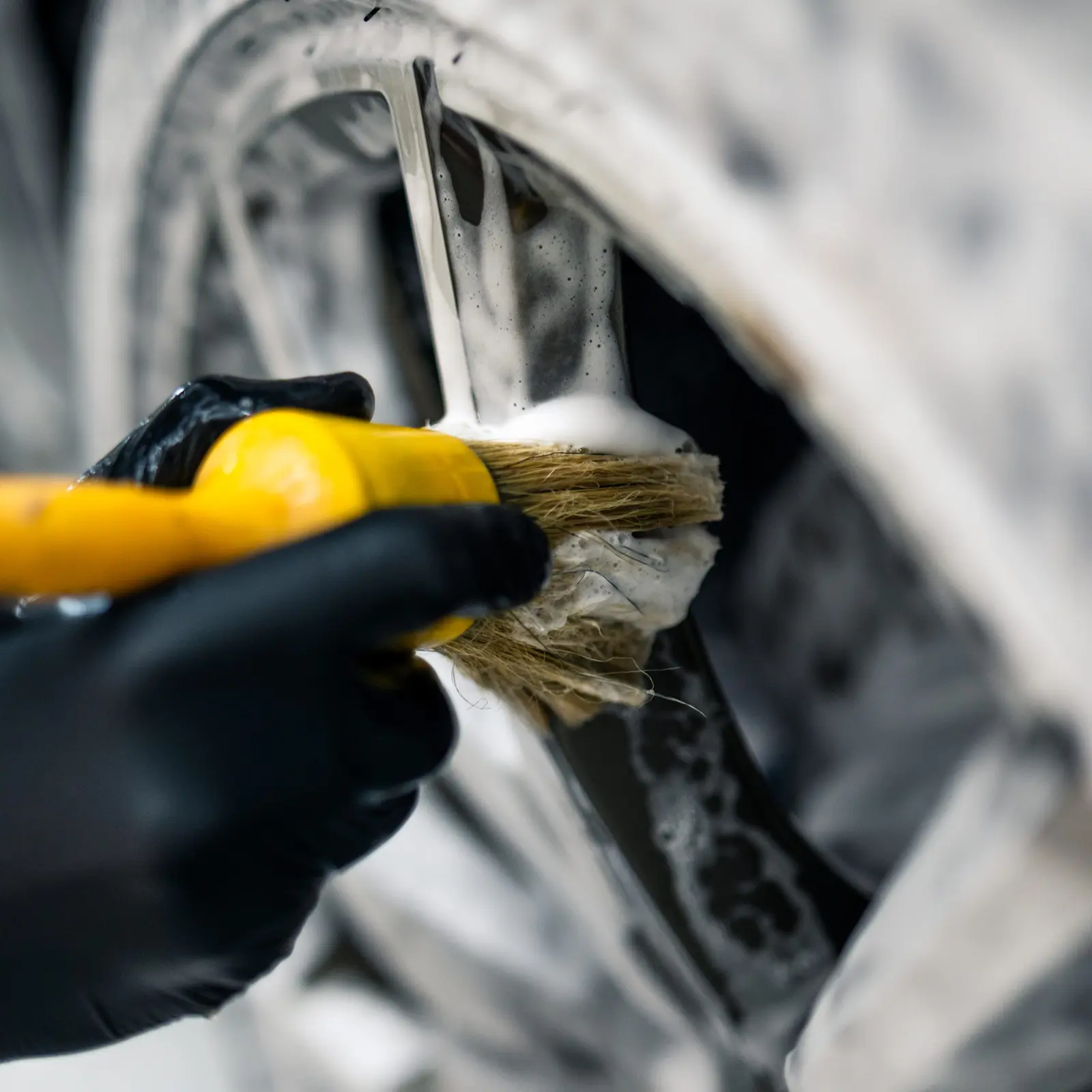
For those we use a product that binds to the iron and pulls it out, instead of etching the metal underneath. It is sold as an iron remover, and you can see it work on your own wheel: wherever there is iron, the reaction turns purple. This step is what we call wheel decontamination.
White spots left behind when water dries
White spots from dried water aren't dirt either. They are limescale and minerals from the water, and an ordinary cleaner won't wash them off, however long you let it work.
Only an acid dissolves them, and a weak one is enough: citric acid, the kind you know from the kitchen. It is far weaker than gel wheel cleaners, and it stays on the wheel only briefly before we rinse it away.
Two different kinds of dirt, two different chemistries. Neither time was it the stronger cleaner that helped, but the one that matched what was on the wheel. Limescale dissolves and rinses away. Iron can't be dissolved at all: it has to be bound and drawn out.
Dull patches that polishing won't bring back
A dull patch isn't dirt that stayed on the wheel. It is the mark of a cleaner that, in those few minutes, dealt with the metal underneath as well.
Cheap gel cleaners that promise clean wheels in seconds are built on a strong acid. On the ingredients list you'll find it as hydrofluoric or hydrochloric acid. An acid like that reaches straight for the metal under the grime and dissolves it within seconds, and that is exactly why it works so fast.
The damage it leaves isn't a layer on top that could be taken off. It is a change in the metal below the surface, and neither polishing nor a new protective coating brings it back.
When you reach for the strongest degreaser
Next to the acids, the shelf holds strong degreasers for the heaviest grime, and they look like the safe alternative. On an aluminium wheel they do the same thing.
Aluminium dissolves at both ends of the shelf: an acid and a strong degreaser both reach for it, just from opposite sides. Anodised wheels are no exception. Anodising is a hard layer the aluminium grows on its own surface, often dyed in the same step; you'll know it by the deep coloured metallic look with no lacquer over it. A degreaser takes that hard layer off as reliably as an acid does. With longer contact the lacquer softens as well, and softened lacquer scratches easily when it is wiped, so one fault turns into two.
The scale below shows where each product on the shelf belongs, from the two ends to everything that lies between them. Drag it across and you'll see what each one does to the wheel.
Interactive pH × substrate
Wheel cleaner chemistry vs substrate
Use the pH slider and substrate selector to see safe / caution / unsafe zones. Markers show typical pH of commercial products.
Safe zone
OKpH 7.0 is inside the safe window for coated / clear coat. Standard cleaning with no elevated risk.
When the bottle says "safe for all wheels"
Halfway between the two ends sits a cleaner that only lifts the dirt off the surface instead of dissolving it along with the wheel. It isn't one particular product but a whole group; on the bottle, look for it as an all-purpose wheel and tyre cleaner. It works more slowly, and the slowness is the difference. For it to be enough, the dirt has to be on the surface, not in it.
The words "safe for all wheels" on a bottle like that hold for six of the seven wheel finishes you'll come across: lacquered aluminium, powder-coated aluminium, raw aluminium, machined billet, chrome plating and anodised surfaces. The seventh is magnesium-alloy wheels.
When you don't know whether your wheels are magnesium
Magnesium wheels look like aluminium ones, and by eye you won't reliably tell them apart. You'll meet them mostly on sports and bespoke wheels.
On magnesium, an acid reaches the metal far faster than on aluminium; a strong degreaser works at roughly the same rate as it does there. And "roughly the same" on aluminium means a permanently dull surface, as irreversible as the one a strong acid leaves. The gentle middle of the shelf, the one that is fine for the other six finishes, doesn't hold for magnesium either.
If you're not sure, send us a photo of the wheel and its type designation. We'll look into it for you and tell you what your wheels can take.
When the same orange specks come back
A washed wheel stays clean until the next dose of brake dust bakes itself into the surface. On a car that is driven every day, that is a matter of weeks. Then you are back at the start: an iron remover again, because the iron again isn't sitting on the surface but held in it.
What lands on your wheels isn't up to you. The finish, though, is the one of the three things you can do something about in advance, before the dirt arrives. We can put a hard, slick film on the wheel, one that a hot iron particle bites into far less easily than it does into lacquer or bare metal. Most of the brake dust then stays on top and comes off in an ordinary wash, so decontamination comes round far less often. We use the Wheels and calipers add-on of ceramic surface protection for that.
It doesn't make the wheel indestructible and it doesn't take the place of washing. If a thorough wheel wash a few times a year is enough for you, you haven't neglected a thing. This is for wheels that keep coming back with the same complaint.
Why the same bottle behaves differently at home and in our studio
That leaves the last of the three, and it decides the outcome even where the cleaner is the right one: how long it sits on the wheel.
The cleaner has to stay wet and be rinsed off before it starts to dry. As the water evaporates, what is left on the wheel concentrates, and a gentle product becomes an aggressive one. It holds for the gentle middle of the shelf too: once it has dried, it isn't gentle.
So the same bottle lifts the dirt off a wheel that has cooled, and on a wheel baking in the sun it dries before you get to the rinse. We wash wheels in the shade, section by section and cool, not the whole car at once.
It isn't that we have chemistry you can't buy. It is the extra half a minute the product spends on the wheel, and you can keep to that at home as well, when you rinse the wheels yourself between visits.
Of the three, only one shows itself on your own wheel: orange specks, white spots or dull patches. What finish lies underneath can't be read off the wheel or off the bottle. And the third, how long the cleaner sits there, is decided by whoever is standing at the wheel.
So we look at the wheels first and reach for the chemistry second. In our studio that is a decontamination wash. Tell us what wheels you have, and we'll advise on what they can take between visits too.
Topic: Washing and drying
More in this topic