
Washing and drying
Washing Your Car Between Visits With No Hose or Drain
3 minEstimated reading time — roughly how many minutes it takes to read at a normal screen pace.
Without a hose or a floor drain, dust and bird droppings build up on the paint, and an ordinary cloth can scratch it. We show you which washing technique works with just a bucket, which works with no water at all, and where each one hits its limit.
On this page
On this page5
The car sits for a week at a time on an estate car park with no assigned space, under a carport at work, or in a garage with no drain in the floor. No hose anywhere. By now a film of dust has settled on the paint, along with yellow pollen, a few bird droppings and handprints around the door handles.
There is a cloth in the boot, and you are deciding whether to run it over that paint.
Between visits to our workshop you can look after the paint without running water. The technique changes with what you happen to have by the car — and past a certain amount of dirt, the car cannot be washed at home at all.
What the dry cloth from the boot does
That cloth is not travelling over clean paint. Dust and small grains of sand catch between its fibres and then behave like fine sandpaper: the scratches appear even if you move the cloth only a few centimetres.
Worse, the same spot on the cloth passes over the bonnet, the door and the wing. A grain from the bonnet gets carried around the whole car, and that is called cross-contamination.
Both techniques that make sense at home solve a single thing: where that grain goes before the cloth touches the paint. It is why, on your car, we change cloths far more often than washing would seem to require — and why a maintenance wash is not done with one towel from the window to the wing.
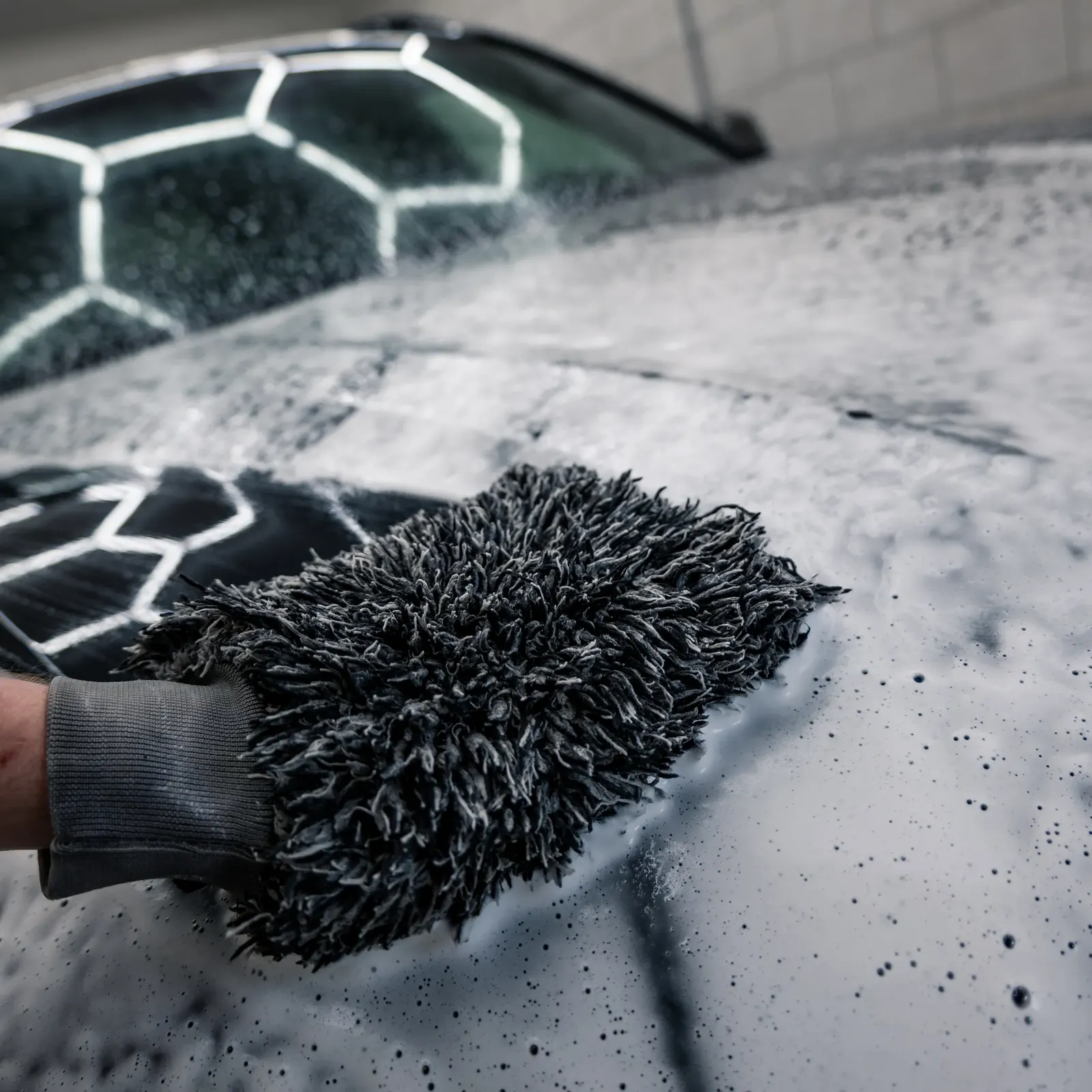
When you have a bucket and a set of clean cloths
A bucket is enough even without a hose, but it needs a larger set of clean microfibre cloths — not one. You use one cloth on one panel or a smaller part of it, then drop it in the bin for dirty cloths. It does not go back in the bucket: that would soak the sand from the bonnet into the water you wash the doors with a moment later.
This is called the bucket method, and where the risk of cross-contamination is highest, it is the standard choice in our workshop too, not a home improvisation.
When the water barely runs to a few litres
If all you can carry to the car is a canister or a few bottles, that is not enough for the bucket method. What is left is rinseless washing: you mix the product into a few litres of water, run a cloth over the paint and wipe it dry, and nothing is rinsed off.
Against the dry cloth from the boot, the difference is what happens to the grain of dust — the solution encapsulates it and lifts it off the paint, so it is the liquid that carries it away, not the fibre of the cloth.
It works under two conditions: you dilute the product exactly as the instructions say, and the paint is only dusty, not muddy. This is how a garaged car can be kept up, and a car in winter, when a hose is out of reach.
When the car is muddy rather than dusty
Dusty, not muddy — that condition does not apply only to rinseless washing, but to both techniques. A film of dust, pollen and prints around the handles you can manage; a layer of mud off a field track, sand in the sills and dried dirt behind the wheels you cannot.
With a car in that state, starting at home does not pay off at all. Without a rinse first, which is called a pre-wash, the dried dirt only smears across the paint, and the scratches you have been avoiding all along are made in a single wash.
For this state there is the decontamination wash: the coarse dirt comes off the paint under a jet of water before we touch it at all. After the wash we go over the paint with you and show you where the scratches from dry wiping already are.
Where to start with your car
Two things decide. What you have by the car sets the technique — a bucket and a set of cloths, or a few litres of water and a rinseless product. How dirty the car is decides whether to touch it at home at all.
On paint with ceramic surface protection the same holds. We install the coating as a certified FEYNLAB® installer, and when we hand the car back we show you on it how to wash it between visits and how to work with a microfibre mitt.
Not sure which of these fits your car? Write to us about where the car stands between washes and how often you get to it with a cloth.
Topic: Washing and drying
More in this topic