
Washing and drying
Paint Decontamination: At Home or in the Studio?
3 minEstimated reading time — roughly how many minutes it takes to read at a normal screen pace.
After a wash the paint still feels gritty, with rust-coloured dots and specks of tar on it. A wash no longer lifts that layer, decontamination does. We show what you can do at home and when to leave it to us.
On this page
On this page6
Run your fingertips over freshly washed paint. The car looks clean, but the surface drags like fine sandpaper, and on lighter paint you will also see tiny rust-coloured dots and black specks. This is not dirt you failed to wash off. It is a layer that an ordinary wash does not remove – and every car picks it up over a few months of driving.
Where it comes from
The rust-coloured dots are iron particles from the brakes, the black specks are tar from the road. Park under trees and you add resin; after winter and after the sprinklers, whitish mineral deposits from hard water.
All of this bites into the paint and holds on. Shampoo dissolves grease and dust, but it simply flows around these.
They can be removed, though it takes different work from washing. We call it decontamination, and it has six steps in a fixed order. You can do the first three at home; at the fourth you run out of equipment.
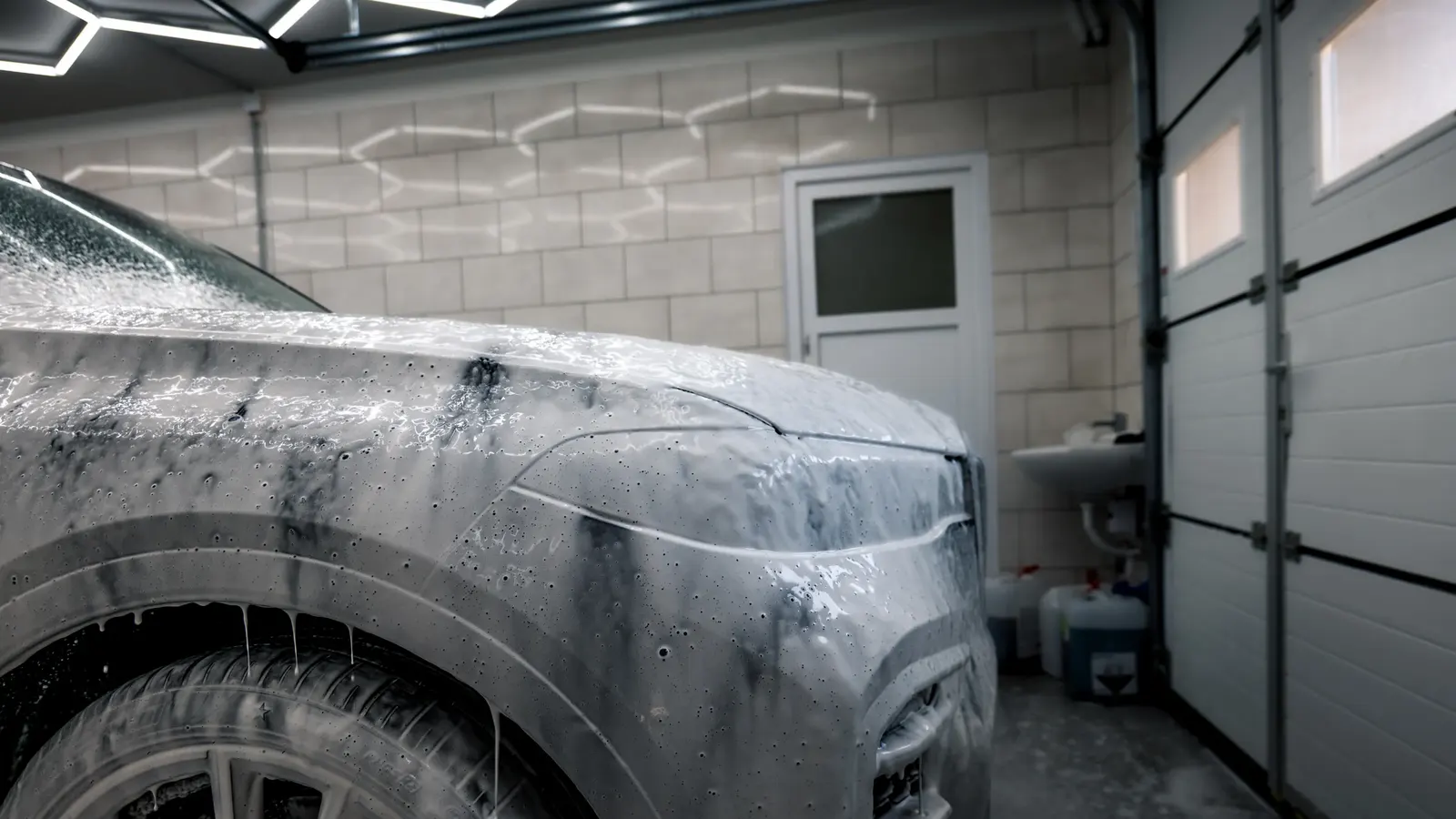
The six steps, and where you stand in them
For your part you need a neutral car shampoo, a product for iron and tar deposits – sold as an iron remover – and plenty of clean towels.
- Rinse off the coarse dirt. Any sand left on the paint ends up on your towel and gets ground into the surface.
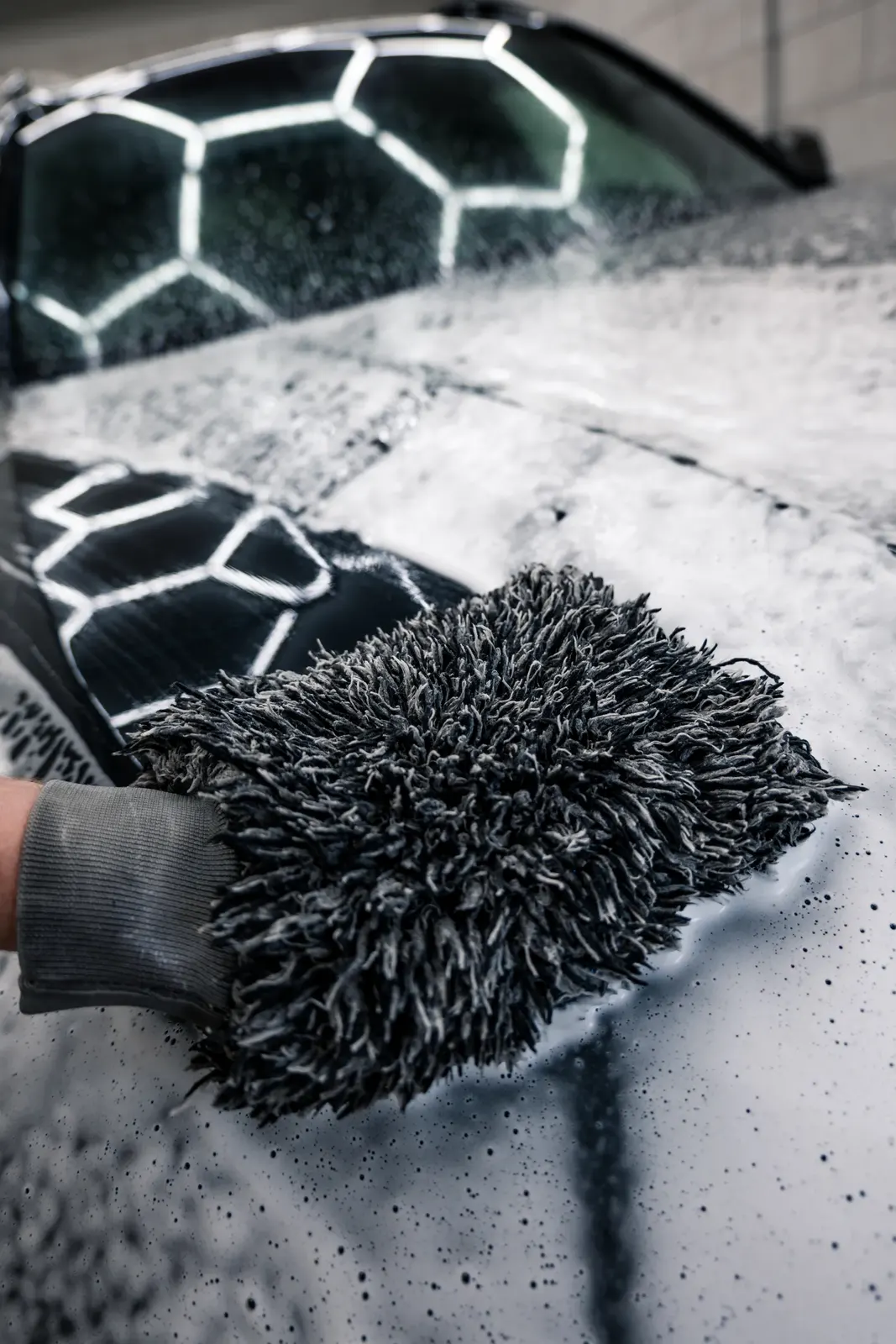
- Wash the car in contact with the paint. Either by the two-bucket method, where you rinse the towel after every pass in a separate bucket of clean water rather than in the wash solution, or with one bucket and enough towels. The point is not to carry dirt back onto the paint.
- Let chemistry work on the paint. The iron remover is left to dwell and then rinsed off; the rust-coloured dots turn purple as it works, so you can see where most of them sit.
- We pull the rest off mechanically. A piece of clay is moved back and forth across the surface with lubricant until the paint glides smoothly, with no resistance left. It takes off what the chemistry could not.
- We degrease the paint, so that the next layer, protective or cosmetic, bonds to a clean surface.
- We go over it with an LED light. It picks out residual traces, so you can see whether the paint is clean both to the touch and under light.
Interactive diagram
Two buckets vs. one — where does dirt end up?
Use the slider to simulate panels washed and toggle between modes. Didactic only — real behaviour depends on hose setup, soil level, and Grit Guard quality.
Grit Guard working
Dirty water drops below the grid in B; bucket A stays the cleaner working bath.
Working bath
Clean water to rinse the mitt
White grains = abrasive particles from the paint
How long the first three steps take depends mostly on how long it has been since the car had a proper wash. Regularity does more here than the strength of the product – fresh tar needs less chemistry and less time than tar that has been baking into the paint since spring.
What we finish on the car
We take over steps four to six as part of a decontamination wash.
Besides the clay and the degreasing, it mainly covers what is hard to reach at home – sills, the areas behind the wheels, the rear end. That is exactly where most of it collects. The job is done when the paint glides the same way across the whole car and no traces remain under light.
When there is something else under that layer
Sometimes the paint shows more than dirt: scratches, weathering, lost gloss. Decontamination will not shift those, because it deals with what lies on the paint, not with what is in it – we cover that in The Paint Is Clean but Has No Depth.
If you can already see this on your car, tell us straight away. We will most likely recommend detailing – it includes the whole decontamination and adds work on the surface itself, so you will not be ordering it twice.
Before ceramic or film goes on the paint
If you are planning ceramic surface protection or PPF film, decontamination comes first, mostly because of the fifth step. The protective layer bonds directly to whatever is left on the paint after degreasing – and that holds just as much for a product you buy yourself as for a ceramic coating from us.
Embedded particles left under the protection stay there for as long as the protection lasts, and that means years. The pricier the car or the protection, the more it is worth being sure the surface is clean before application. That is why we look at the paint before we agree a date.
Tell us if the paint drags after a wash
Run your fingers over it and tell us what you feel and how long it has been since the car had a proper wash. If you can also see something on the paint – rust-coloured dots, tar, scratches – add a photo in bright light.
We will tell you from that whether the first three steps at home will do, or whether it is worth leaving the rest to us.
Topic: Washing and drying
More in this topic