
Changing the look
Matte Paint: How to Protect It, Not Lose the Look
3 minEstimated reading time — roughly how many minutes it takes to read at a normal screen pace.
Matte is a property of the surface's microscopic structure, not the paint colour, and ordinary ceramic protection can fill it in. We explain why that happens and what kind of protection keeps the matte look instead.
On this page
On this page6
You have a car with matte paint — from the factory, after a respray, or wrapped in matte film — and nowhere on it do you see a sharp reflection. Sooner or later the question comes up: what will the first wash, the first wax or the first protective layer do to that surface. Some people ask in advance, others only because a glossy patch has appeared on the car.
Matte isn't a colour, it's a state of the surface — and a surface can be filled in or rubbed away. We'll show you what the matte look on your car rests on, what takes it off, how to recognise a layer that leaves it alone, and what to do when the patch is already there.
When you look at the paint up close
Your paint isn't a different colour from glossy paint, its surface is shaped differently. Under high magnification you'd find small peaks with valleys between them; on a glossy car, a smooth plane in the same spot. Those irregularities scatter light sideways, so no sharp mirror image forms in the paint.
It isn't only an impression, it's a dimension — roughness, written as Ra in the reports: glossy paint stays under a tenth of a micrometre, matte sits noticeably higher. We take that number on your car before the work and after it, so you have proof that your matte look stayed the same.
Interactive comparison
Why matte clear coat needs different ceramic
Toggle standard ceramic vs SEVEN Works Matte Ceramic. Use the slider for matte clear coat level (light satin → super matte). Cross-section and light behaviour are on the right.
Matte Ceramic — bridges peaks only
CorrectSEVEN Works Matte Ceramic has modified rheology — it bridges micro-peaks but not valleys. The paint micro-topography is preserved, diffuse light scattering continues, and matte stays matte.
In the demo, move between the two surfaces and you'll see what happens to the matte look once the peaks are smoothed over. On a car there are two routes to that, and both are common.
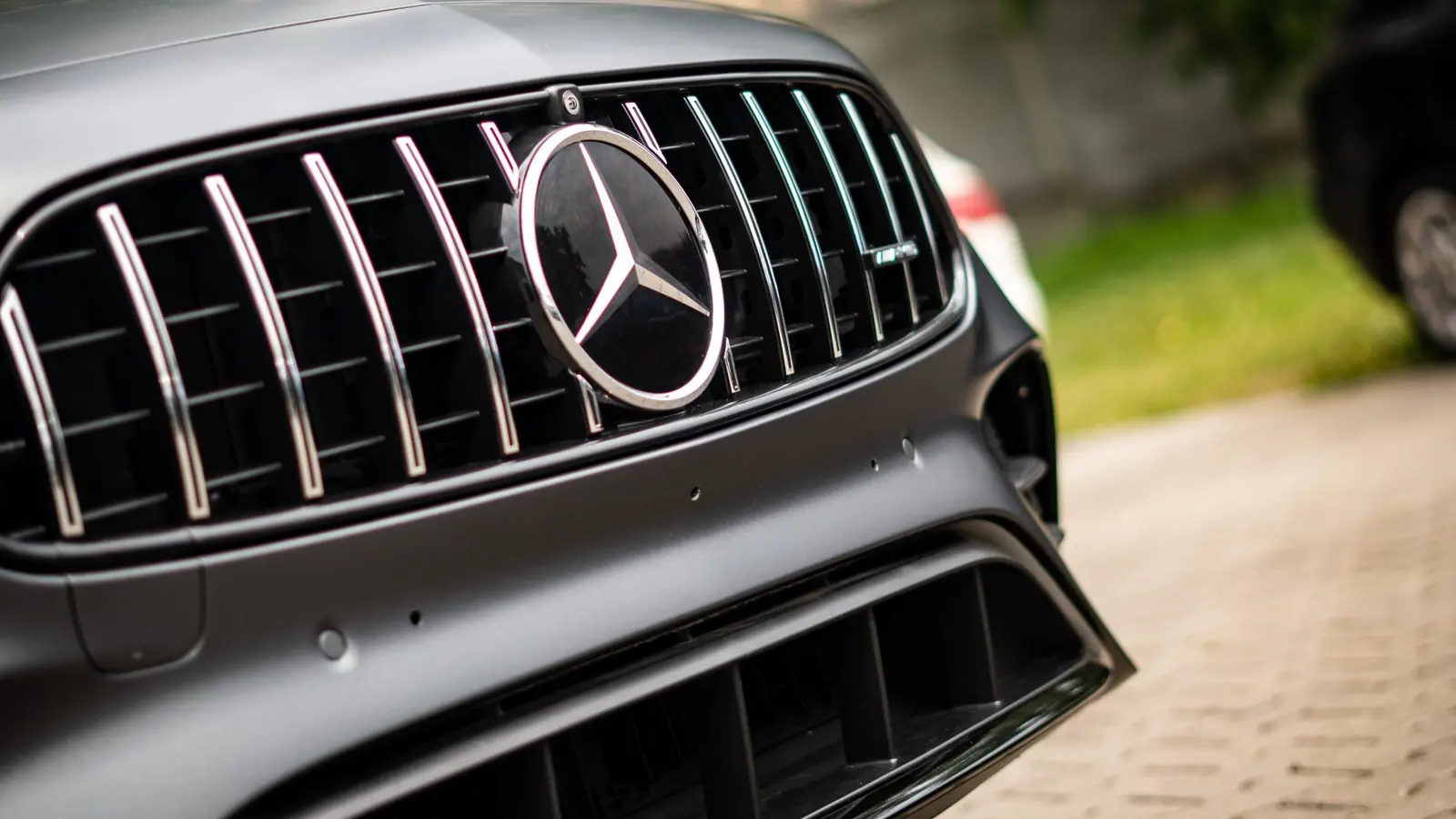
When a car leaves the workshop glossier than it arrived
Most ceramic protection is built for glossy paint: it's meant to flow out into a continuous layer and level out the irregularities underneath. On a glossy car that's exactly what you want — the layer evens out micro-scratches and adds depth. On matte paint it would also level out the very irregularities the matte look rests on.
Wax ends the same way, only briefly: it sits on top of the paint and a few washes take it off, but before it goes, its continuous film drops the matte look to a semi-gloss.
Under the workshop lights you'll miss it. At home in daylight you'll see a bonnet shining more than the rest of the car.
When the glossy patch shows up after a wash
It isn't only a layer that takes the matte look off you. Ordinary paint cleaning removes it just as reliably, most often a clay bar: it's dragged across the surface under pressure and lifts the matting particles out along with the baked-on contamination. Wherever it passed, a glossy patch stays behind.
A wash tunnel does the same thing more slowly: the brushes go over the paint again and again, and the hardest-worked areas start to shine before the rest of the car.
If the patch is already on your car, what happens next depends on where it came from. A layer that filled in the matte sits on top of the paint and can be worked with. Matting particles lifted out by a clay bar or a brush, though, no protection will put back — at that point we're talking about a respray or new film. Which of the two you're dealing with, we can tell on the car; from a photo we can't.
How to recognise a layer that leaves the matte alone
Ask two things — of us, and of anyone else who touches your matte paint.
First: what the layer does to the valleys. On matte paint it may cover the peaks only, and must not run down into the valleys between them. You won't read that off a label or a price list; it shows up only in a test on the car.
Second: how long it lasts. Protection for Matte Paint That Keeps It Matte has a silicon base and bonds to the paint chemically, so washing won't take it off — unlike anything that merely sits on the paint and has to be redone every few washes.
What we do before we touch the whole car
First we need to know what we're protecting: factory matte paint and matte film each tolerate different things. A photo is usually enough for that; otherwise, bring the car in.
Then we wash and decontaminate it, measure the roughness and do a test patch somewhere hidden — under the boot lid, say. We look at it in daylight and measure it again. If the matte holds, we go over the whole car; if it doesn't, you've lost a patch under the boot lid, not the bonnet.
What to do next
Write to us with what the car is and what you're planning for it — whether this is protection in advance, or already a patch. We'll tell you whether your matte look stays, or whether the layer you have in mind would fill it in.
Protection for matte paint is in the price list under Ceramic Surface Protection. It isn't the ordinary glossy layer that would fill in your valleys; which version your paint will take, and how long it will last, we'll say based on the car's condition.
Topic: Changing the look
More in this topic