
New car
Basic or Ceramic Protection? How to Choose
3 minEstimated reading time — roughly how many minutes it takes to read at a normal screen pace.
Paint that sits outside most of the year picks up fine wash-swirls, and water spreads out across it instead of beading up. The price list has two entries, and the price gap is clearer than the gap in the result. We'll recommend the one that fits how you actually use your car.
On this page
On this page5
Paint that sits outside most of the year and picks up fine wash-swirls needs more than a choice made on price. Our price list has two entries for paint protection – basic and ceramic surface protection – and the price difference is obvious at a glance, the difference in the result isn't. Pick by number alone and you can end up overpaying for a layer your car's routine doesn't need, or underprotecting paint that spends most of the year parked outside. Here's what separates the two levels, and what you can actually base the choice on.
What sets one level apart from the other
It isn't just price – it's how long the layer holds up and how well it stands up to everyday driving. Basic protection lasts a shorter time, and you're expected to renew it. We offer ceramic protection in several lines with a lifespan from one year up to five years depending on which line you choose, and it reaches 9H on the pencil hardness scale. A ceramic layer also brings higher hydrophobicity: water beads up on it and runs off, instead of spreading out across the paint.
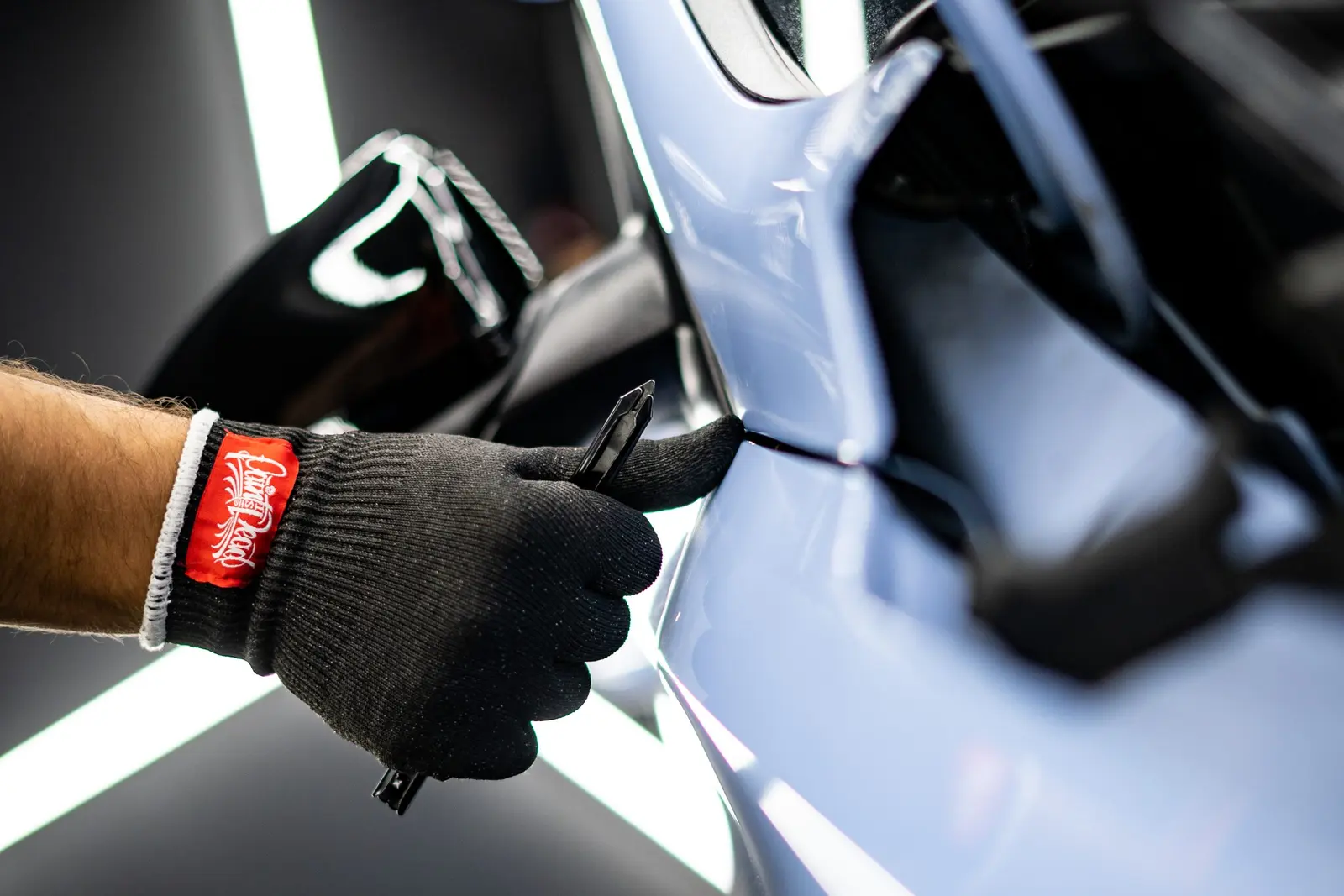
What self-healing adds
Ceramic protection can smooth out fine wash-swirls and light scuffs on its own once the surface warms to around 50 degrees. How much a surface can heal itself varies between ceramic layers, from partial healing to coverage across almost the whole panel. For a car that's driven daily and washed often, this is one of the differences you'll notice before you notice the difference in years of lifespan.
Interactive decision guide
DIY nebo studio?
Tři otázky, jedna odpověď. Decision tree porovná stáří vozu, požadovanou korekci a vaši cílovou hodnotu výsledku.
Answered 0 / 3
Answer all three questions and receive a specific recommendation.
The demo shows what separates a DIY kit from work done in the studio – from who applies it to the care training that comes with ceramic protection done in the studio.
What to base the choice on when your paint isn't standard
A glossy finish can take either level of protection. A matte finish narrows the choice: a standard gloss layer would change how a matte finish looks, so it's worth talking to us about what makes sense for your paint. A car with PPF or vinyl wrap handles paint protection differently – the film or vinyl protects a different, flexible layer, not the one this article is about.
When we'll suggest a different route
If your car has a wrapped bonnet or a full vinyl wrap, this article doesn't apply to the paint underneath the film – get in touch and we'll talk through what the film or vinyl actually needs. Choosing between basic and ceramic protection isn't about how much you want to spend, it's about how long and how often the car sits outside.
What happens next
The price of ceramic protection depends on the line you choose, the number of layers and the condition of the paint before application, so we'll agree the exact figure once we've seen the paint. A longer lifespan on its own doesn't mean the better choice for every car. Tell us how you use the car and how long you plan to keep it, and we'll recommend the level and line that matches – as a certified FEYNLAB installer.
Topic: New car
More in this topic