
Washing and drying
A Car with PPF Film: How to Wash It So the Edges Last
4 minEstimated reading time — roughly how many minutes it takes to read at a normal screen pace.
A lifted corner of film at the bumper, or a milky haze along the edge of the bonnet — after only a few washes, though the film looked flawless when installed. The bonded panel takes ordinary washing; the edge does not, and there the pressure, the distance and the angle of the nozzle decide. We explain what harms an edge, how to wash a filmed car safely and when it is better to leave the washing to us.
On this page
On this page7
Film on a bumper or along the edge of the bonnet looks flawless right after installation, and then, a few washes later, a lifted corner or a milky haze shows up at the edge. In the middle of a panel this doesn't happen – there the film lies flat across its whole area and is tougher than the paint underneath. What breaks is the edge, where the film ends and meets bare paint.
Two things meet at that edge. Water, which tries to get under the rim – and how hard it pushes is decided less by the pressure dial than by where you aim from, at what angle and with how wide a jet. And the adhesive, which holds the rim down – that can be weakened by hot water, by harsh chemistry, or by salt that stays on the car all winter. Between those two it is decided whether the film lasts for years or starts lifting after a few months.
Where the film ends on your car
Bumpers have the most edges. Around the grille, around the headlights and fog lights the film folds into complex shapes in a small space, and there are more rims there than anywhere else on the car.
Another edge runs around the frame of the bonnet, more sit on the doors and the handles. One more hides on the sill under the rubber trim, which is exactly where you step as you get in. Mirrors and the A-pillar have edges folded in every direction.
In the middle of the bonnet, in the middle of a door or on the roof, don't go looking for an edge – there the jet of water has nothing to push against.
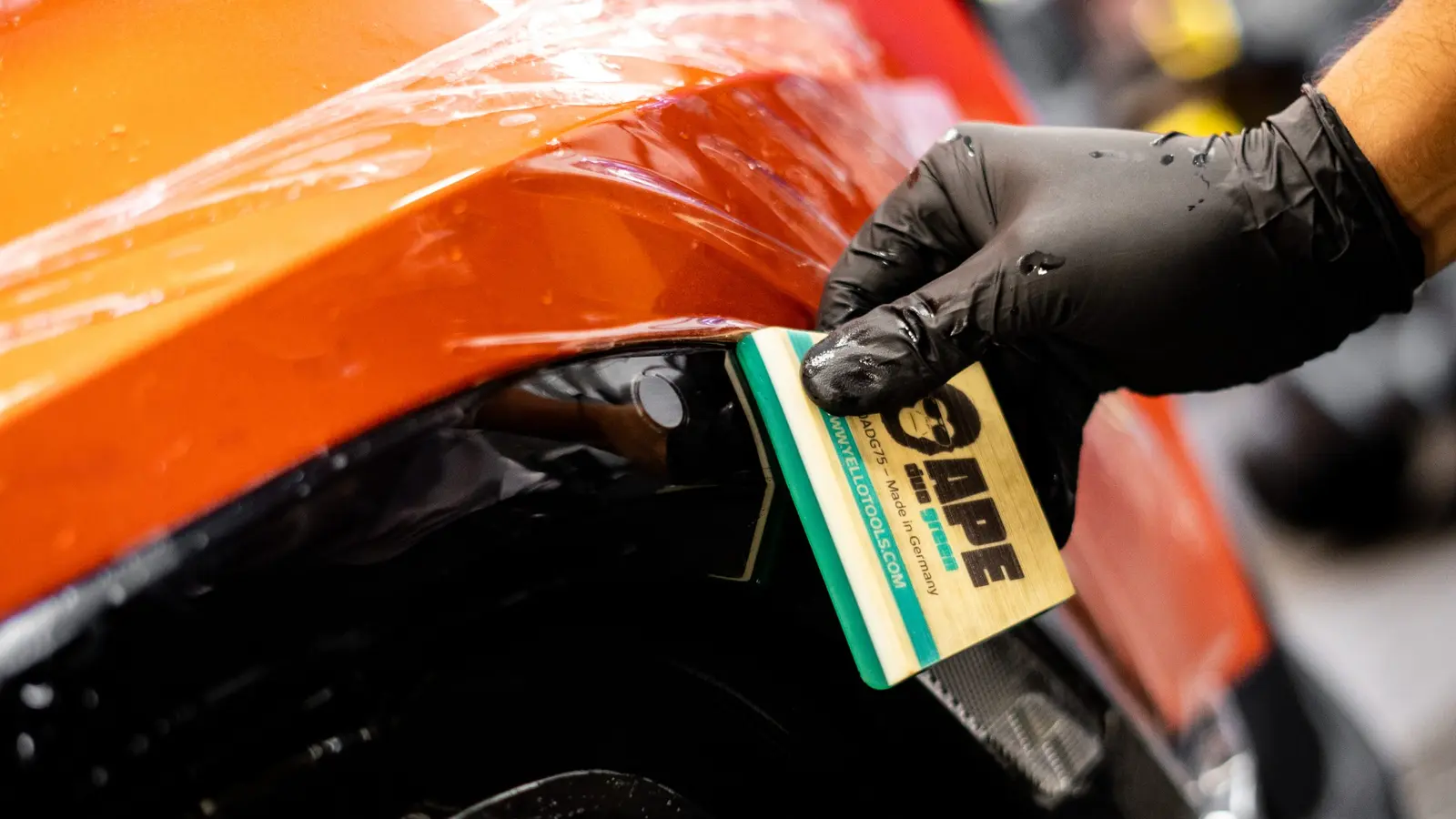
When you're standing at the bumper with the lance
It matters less how long you stand at the bumper than where you point while you're there. A jet aimed square at the edge of the film gets under the rim and lifts it, while the same jet led at an angle along the panel and out across the film only slides over it. So run it along the panel, not against the edge.
The second thing you hold in your hand is distance. Thirty centimetres isn't a round number out of nowhere – somewhere around there the force of the jet reaches the limit of what the adhesive under the rim will hold, and every centimetre closer raises it. At the bumper and at the sill that means taking a step back rather than turning things up.
You can try the angle and the distance dry, before you put any water on the car.
Interactive zone map
Pressure washing on PPF: safe angles and distances
Posuvníky nastavte úhel trysky vůči hraně PPF a vzdálenost od panelu. Mapa vpravo ukazuje, kde jste — od bezpečné zóny po kritický úhel, kde se PPF okraj zvedá.
Safe zone
SafeDistance ≥ 1 m, angle parallel to the PPF edge. A 40° fan nozzle distributes pressure over a larger area; kinetic energy at the PSA edge is below the delamination threshold. Safe to wash the entire car here.
The nozzle left in the lance from last time
The third thing is the nozzle, and it decides how large an area the force of the jet spreads over. Narrow nozzles – marked 25°, and above all the so-called zero-degree and turbo ones – drive all of it into a single point. There neither the right angle nor the right distance is enough, and even a flawless installation won't help: the edge starts peeling within seconds. A car with film wants the widest fan your washer has, and nozzles are usually marked on the body.
Only now does the pressure dial come up, and that's why so late. It sets the force, but of the four things it does the least with it: the 100 to 150 bar an ordinary domestic washer puts out is fine for film as long as the fan, the angle and the distance are right. Above 150 bar the car won't get any cleaner either – you'll only add force at the edge.
When you reach for hot water or for foam
So far this has been about the force pressing on the edge. The other half is the adhesive that holds it down, and that can be weakened before the first drop even lands on the film.
Hot water dissolves grease better, which is why many people reach for it. But above 60 degrees Celsius the glossy top layer of the film softens and the edge ripples even when everything else is right. Don't put water above 60 degrees on film.
Cheap snow foams tend to run pH 11 to 13, and the same goes for most degreasers and wheel cleaners. On bare paint that passes; at the edge of film it doesn't – chemistry like that also dissolves the sealant that often sits under the rim as a second barrier. So make sure everything you put on the film says pH 9 or lower on the label.
Road salt, unlike foam, isn't something you choose. It does the film itself no harm, but when it stays on the car all winter it weakens the adhesive precisely at the edge. In winter, then, rinse the edges between the big washes too, with lukewarm water and no chemistry.
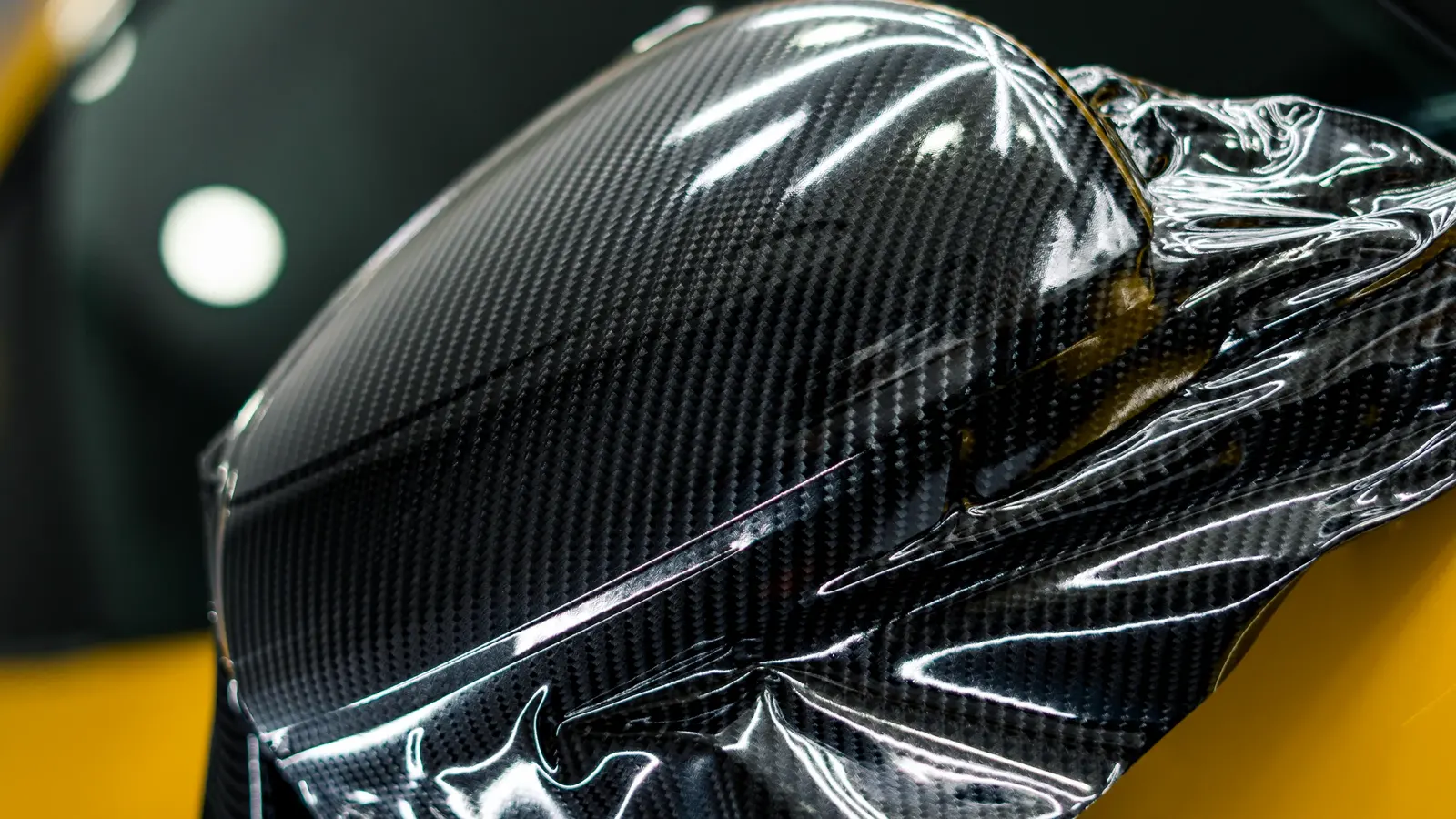
When you're deciding on a touchless wash
A touchless wash avoids brushes, and even so it isn't safe for a film edge. Its nozzles point square at the bodywork, the distance is fixed by the shape of the arch, and you don't get to choose the fan – of the three things you hold in your hand with a lance, you have none of them there.
It's the one point in the whole wash where the jet isn't yours to decide. On a car with film on the bumper and the sills, hand washing therefore wins, because there you keep the angle, the distance and the nozzle under your own control.
When the corner is already lifted
A lifted edge won't come back with washing, and neither will a milky haze along the rim. Both are news about the edge, not about the panel, and both are dealt with by a fresh PPF film installation on the part concerned.
Write to us with which film you have and where the edge or the haze is bothering you, and add a close-up photo of the spot. From that we can tell whether replacing the film on one part is enough, or whether it makes sense to redo the whole bumper.
Next time you go to wash the car
The whole guide fits into one sentence: the widest fan, more than 30 centimetres of distance, the jet along the panel and out across the film, water up to 60 degrees and nothing harsher than pH 9.
When you haven't the time or the inclination for that, maintenance washing for a protected car allows for the adhesive under the film and for an edge that takes different water from the rest of the bodywork.
Topic: Washing and drying
More in this topic