
Changing the look
Milky Spots Under Window Tint: Is That Normal?
3 minEstimated reading time — roughly how many minutes it takes to read at a normal screen pace.
A few days after tinting, milky patches show up under the film and look like something went wrong. We explain where the water comes from and how long it takes to clear on its own, and how to tell it apart from an air bubble that won't.
On this page
On this page5
In the morning you look at a side window against the light and see milky patches or tiny droplets that weren't there when you picked the car up. It isn't a fault in your car and it isn't bad workmanship – it's water left between the film and the glass after the installation.
Almost always it goes away on its own and there is nothing for you to do but wait. Below you'll find where it came from, how long it takes, what not to do with the car in the meantime, and how to recognise the one case where it's no longer water.
Where the water under the film came from
Window tinting is wet work. Both the glass and the film are wetted with two solutions during the job, and each one serves a different stage. The slip solution is water with detergent: while it's on the glass, the film can be moved around until it sits in exactly the right position. The tack solution is water with isopropyl alcohol and helps the film bond to the glass.
The alcohol from the tack solution evaporates quickly. The water doesn't – some of it stays between the film and the glass. Those milky pockets on the window are nothing else.
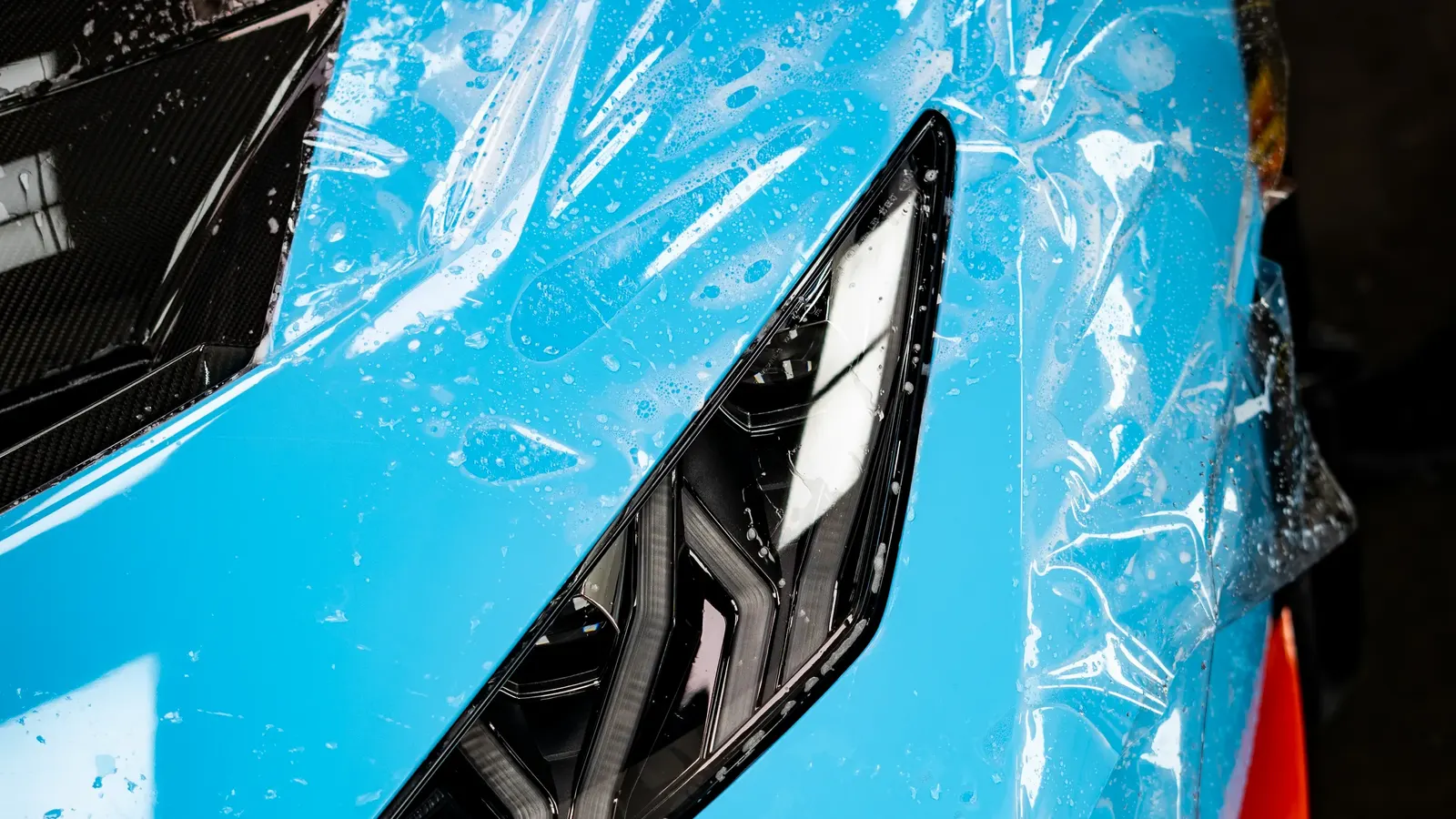
How long the pockets last
The water has nowhere to go except through the film itself. Its molecules are small enough to pass out through the film material over time; this is called diffusion. It does the film no harm and doesn't loosen it from the glass, so nothing is spoiled by waiting.
How long it takes is decided by temperature. In summer it's a matter of days, in cold weather it can easily be several weeks, which is why nobody will give you an exact date in advance. Only one thing speeds it up: leaving the car parked in the sun.
The demo below shows how the drying progresses and which stage your window is most likely at.
Interactive curing
Moisture pockets after tinting — when do they clear?
Slip solution between film and glass evaporates through the polymer. Rate depends on temperature. Summer: 3–7 days; winter: 4–6 weeks.
Curing complete
HotovoAdhesive fully cured, pockets gone. Film has reached maximum optical clarity and adhesion. You may lower the windows, wash the glass, and use the defroster without restriction.
While you can see the pockets, don't lower the door windows
As long as there is water under the film, the tack solution hasn't fully cured and the film holds to the glass only partly. It is weakest right at the edge – where the glass rubs against the seal as it moves.
If you lower a door window at this stage, the seal catches the edge of the film and pushes it up. The film stays permanently rippled along the edge and we can't get it back. It's the seal that damages it mechanically, not the drying.
You have the gauge right there on the glass: while the milky pockets are visible, there is water under the film and the door windows should stay up. The rest of the car isn't affected – you can drive and wash it as usual. The only thing restricted is operating the door windows.
When a pocket stops shrinking
A water pocket gets smaller day by day. An air bubble doesn't change, because air can't get out through the film material and stays underneath it.
That's how you can tell them apart too: if a pocket in summer weather is still there after two weeks and isn't changing size, it isn't water but air. It won't disappear on its own and the spot needs looking at.
If you're not sure, write to us
Send us the installation date and a photo of the spot. Those are the two things that tell us whether it's worth waiting a while longer, or having a look at the glass here at the studio.
It isn't too early to write about it. It's easier for us to look at a photo and tell you everything is fine than for you to stand at the window guessing. Get in touch through the form below.
Topic: Changing the look
More in this topic