
Changing the look
Window Tinting and the Law: What Passes Inspection
3 minEstimated reading time — roughly how many minutes it takes to read at a normal screen pace.
Dark windows, a weaker view into the mirrors at dusk — and at the roadworthiness inspection the technician holds a meter to the glass and the film comes off. The difference between a film that passes and one you'll have to strip is a few percentage points. We'll explain what limits apply and what decides whether the film stays legal at inspection.
On this page
On this page6
Most people picture darker windows across the whole car at once — one shade front and back. But a car isn't tinted as a single piece. The line runs behind the front doors: behind it you can pick the shade almost freely, in front of it the limit leaves the glass nearly clear, and on the windscreen all that's left is a strip along the top.
Up front it comes down to one number, and it isn't the one printed on the box the film comes in. At the inspection the glass is measured together with the film applied to it, and that pair comes out considerably darker than the film on its own. We'll go through the car part by part, from the most relaxed to the strictest, and show why up front you end up with nearly clear glass.
Behind the front doors the shade is yours to choose
For the rear side windows and the rear screen, the law sets no minimum light transmission at all. You can go down to five percent — windows you can't see into from outside.
This part of the car is usually the reason tinting comes up in the first place. The sun stops shining into the faces of children in the back, and nobody can see what you're carrying through the boot glass.
Two conditions apply here. The film mustn't cover the third brake light or the area around it, and the car has to have both exterior wing mirrors — if one is missing, a dark rear screen is out of the question. We check both during installation.
Up front, 70 percent leaves you with nearly clear glass
At least 70 percent of light has to pass through the front side windows. That figure isn't taken from the film, though. The glass and the film are measured together, and the two values multiply — the glass alone already absorbs some light.
Factory glass typically transmits around 78 percent. A film rated at 70 percent applied to it gives 0.70 × 0.78, that is 54.6 percent. That's well below the limit, even if the film felt light in your hand. In practice, to meet the limit on that window you need a film close to 90 percent — one that darkens the glass barely noticeably.
Interactive VLT legality
Window tinting in CZ — what is allowed
Set film VLT for each zone. Combined light transmission = OEM glass (78 %) × film. Rules under Czech Act No. 56/2001 Coll., ECE Regulation No. 43 and Decree 341/2002 Coll. as amended.
Within legal limits
Current combination passes technical inspection. Keep installer certificate in the vehicle (required at roadside checks).
The demo works out exactly that product. The factory glass in it transmits 78 percent, you move the film's transmission, and the zone turns green the moment the result passes 70 percent. How much your own car's glass transmits is usually in the service booklet or the owner's manual.
That line isn't a rule of ours and you can look it up. Act No. 56/2001 Coll. sets the general conditions under which a car may be used on the road, the transmission of the glazing itself and the rules for applied films come from the international standard UNECE Regulation No. 43, and the implementing decree spells out the limits separately for the windscreen, the front side windows and the rear of the cabin.
On the windscreen you're left with a strip along the top
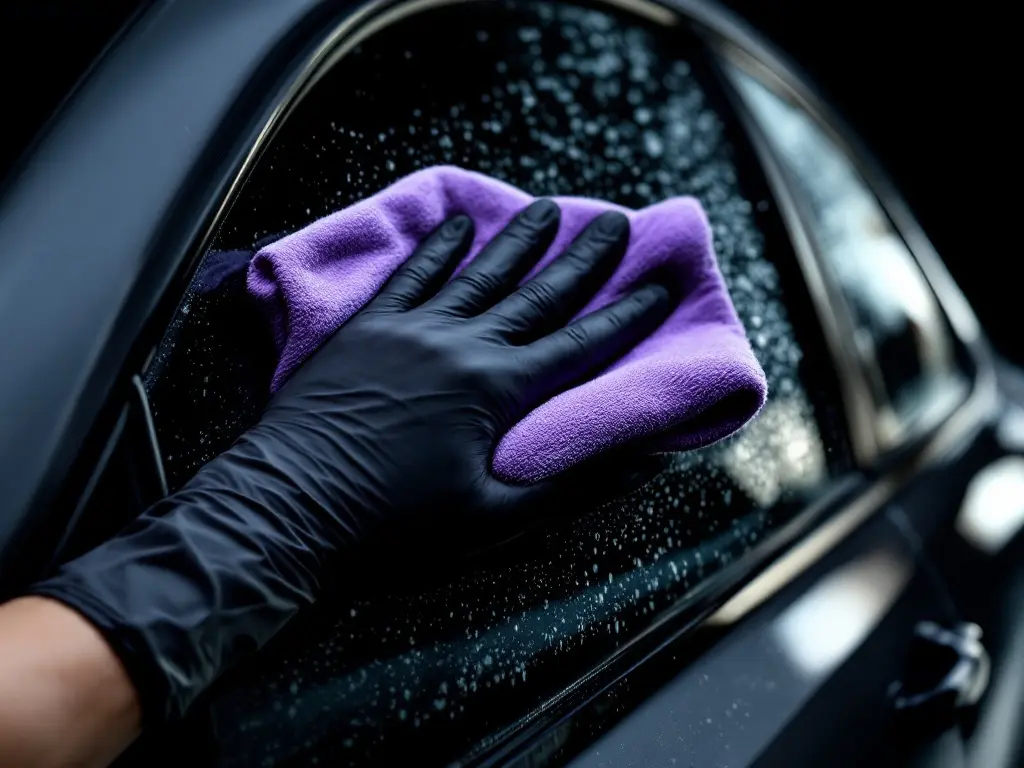
The windscreen is the strictest part of the whole car. Dark film has no place in the driver's field of view, and what's left to you is the sun strip, the top 10 centimetres of the glass. A fully tinted windscreen won't pass the roadworthiness inspection.
If your car has a camera behind the windscreen, by the rear-view mirror, tell us about it. Where the sun strip crosses its view, it has to transmit near-infrared light (NIR), which the camera uses to read the road ahead — otherwise the assistance systems stop seeing.
Clear protective film is a different case from tinting. PPF (paint protection film) and nano-ceramic don't darken the glass, they shield it from flying stone chips, and they aren't approved as tinting films — the Ministry of Transport approves them individually for a specific car. So it's a longer route, and it's worth planning for in advance.
When the car already has film on it
Sometimes the previous owner applied it, sometimes it dates from a time when nobody watched the number. Before the roadworthiness inspection, any film that doesn't meet the limit has to come off — up front that's usually the dark one, at the back it's rarely a problem.
If an inspection is coming up, bring the car to us. We'll measure it window by window, tell you what will pass and what will have to come off, and take the film down along with the adhesive residue.
What you can be asked for at the inspection and on the road
The technician holds the device straight against the glass with the film applied and reads off the value. What it measures is what counts.
During a roadside check, a police officer can ask for documentation of the film — a certificate with the installer's name, the date of application and the type of film. You'll get one from us, and it's worth keeping in the car.
The 70 percent limit on front side windows applies in Germany and Austria too. Film carrying an E-mark under UNECE Regulation 43 is generally accepted across the European Union.
What to do next
So what can be darkened is mainly what sits behind the front doors. Up front the limit leaves the glass nearly clear, and on the windscreen only the sun strip is left.
Write to us about what car you have and what you expect from tinting — whether it's the sun in the back, privacy in the boot, glare above the steering wheel, or old film that has to come off before the inspection. Window tinting — we'll take care of it for you.
Topic: Changing the look
More in this topic