
Interior
Car Smells from the Vents: Where It Comes From
3 minEstimated reading time — roughly how many minutes it takes to read at a normal screen pace.
The smell from your air conditioning doesn't come from the ducts, but from biofilm on the evaporator fins. We explain how it forms and why sprays and ozone won't fix it.
On this page
On this page5
Switch on the fan or the air conditioning and a smell arrives with the air – musty like old socks, and once it has been building for a while, almost sweetly fishy. A few minutes of driving won't clear it, so you carry it the whole way, along with everyone else in the car.
One thing is down to you: when the smell arrives tells you whether the air conditioning is holding it, or the upholstery. The rest is down to us. We'll show you where a smell like that comes from, what its tone gives away, why it returns after sprays and ozone, and what we do about it.
When the smell arrives – with the airflow, or all the time
If the smell appears as soon as you switch on the fan or the air conditioning, and weakens or disappears with the airflow off, the source is the air conditioning. The rest of this text is about that.
If you smell it all the time, even with nothing blowing, and it is just as strong throughout the interior, the source is the interior itself – upholstery, carpets, seat covers. That leads elsewhere: deep interior cleaning, and for a smell that has been there a long time and keeps coming back, extreme interior cleaning.
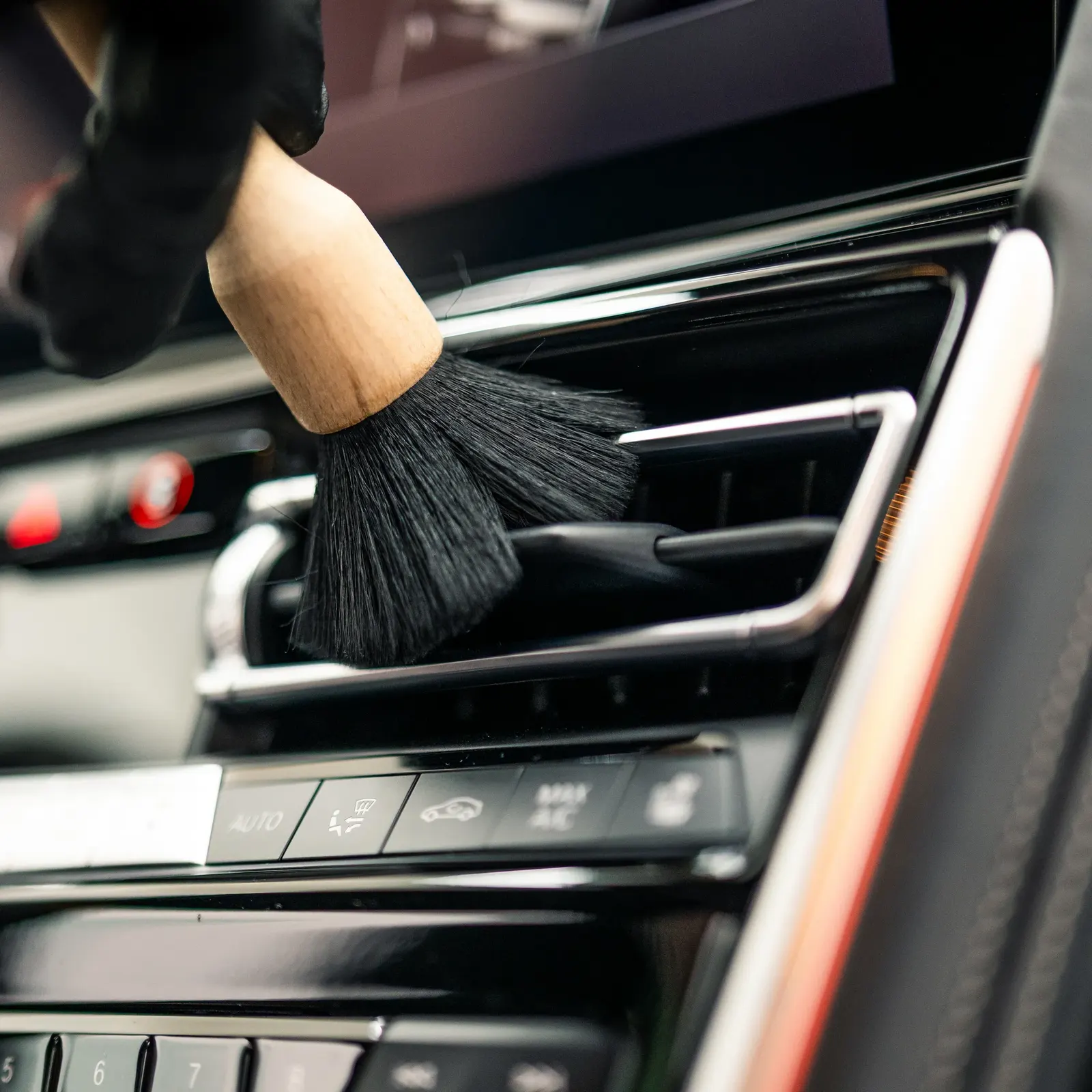
Where it comes from and why you can't see it
Inside the air conditioning the air cools from roughly 25 °C to 7 °C, and it happens on a single part: the metal fins of the evaporator, hidden deep under the dashboard behind a plastic cover. Water condenses on the cold metal and stays there even after the engine is switched off.
So it stays cold and wet between the fins – around 5 to 10 °C and humidity close to a hundred percent. Bacteria do well in that, which is why the coating keeps growing even in a car that is only standing. It isn't dust you could wipe off: on the fins the bacteria wrap themselves in a slimy layer, a biofilm, and it holds them against the metal and shelters them. That is why a coating like that can't be cleaned off the surface – whatever lands on it from above leaves the layer underneath alone. Mould joins it in time.
You can't see it, and you can't reach it through the vents. And because nothing airs out in a parked car, the first blast of air pushes the lot into the cabin at once – which is why that very first breath is usually the worst.
Interactive HVAC
Evaporator biofilm — growth over time
The evaporator stays damp and dark most of the time — ideal for bacteria. Use the slider to set time since the last sanitisation.
Developing biofilm
OdourBacteria (Micrococcus and others) build a biofilm on the fins — a slimy polysaccharide matrix. When the AC is turned on, a faint unusual odor begins.
The demo shows how the coating forms on the fins and what feeds it: moisture, temperature and the organic particles that find their way inside.
What the smell tells you about how far it has gone
Pay attention to the tone of that smell, because it tells you how far it has gone. Your nose is all you need for it.
Mustiness – socks, a damp cloth, a cellar – goes with a younger coating: it is thin and still sits on the surface of the fins. The sweetish fishy note comes later, once the layer is older and thicker and there is more of it. So if what you smell from the vents is fish rather than socks, it has been growing there for some time and you can expect a larger job.
Why the spray, the ozone and a new filter didn't help
Sprays and ozone run into the same wall: they reach the surface, not the matrix. An enzymatic spray put through the grille dissolves the surface layer wherever it lands, but it doesn't run everywhere between the fins, and the mass underneath keeps growing. Ozone, on top of that, breaks down within minutes, so little of it gets behind that cover – you pay for a fragrant cabin and the smell returns the first time you switch the air conditioning on.
A new cabin filter is a different case. The filter sits in front of the evaporator, not on it: a clogged one lets more dust through to the fins, meaning more of what the biofilm feeds on, so a clean filter slows the growth down. What is already on the fins, though, it won't take off.
What we do when you bring the car in
We go through what you've described with the car in front of us and take a look at the cabin filter – its condition usually shows what's going on down under the dashboard.
The smell only goes once someone reaches the evaporator fins directly. That's why we arrange air conditioning cleaning and refilling through a contracted partner who can reach them.
If the smell has settled into the upholstery too, we follow up with deep interior cleaning, so you drive away with the whole car sorted. We'll agree the scope and the price at the inspection.
Write to us how the smell shows up and when it's strongest, or call us on +420 739 374 074 and we'll go through it with you by the car.
Tell us how the smell shows up
Topic: Interior
More in this topic