
Film on the paint
Stone-chip dots on the bonnet and bumper
4 minEstimated reading time — roughly how many minutes it takes to read at a normal screen pace.
Small dots on the front edge of the bonnet and on the bumper are spots where a stone chipped out a piece of paint. We'll explain why polishing won't remove them and what can be done about them. We'll also show how PPF film on the front stops further ones and what the price depends on.
On this page
On this page8
Stand by the bonnet so the sun hits it from the side. On the front edge of the bonnet and on the bumper, small dots appear, some pinhead-sized, others like a tiny crater. You won't see them from a distance; up close you'll count dozens. Each one is a spot where a stone thrown up by the wheel of the car ahead of you struck and chipped out a piece of paint.
Why it's always at the front
Stones, sand and pieces of asphalt fly up from other cars' tyres and travel toward the front of your car. The faster you drive, the harder they hit. That's why most of the dots are on the front edge of the bonnet, on the bumper, on the mirrors and on the headlights, and why they build up mainly after motorway driving. Keeping your distance can reduce this, not stop it: you can't control a stone thrown up by an oncoming or overtaking car's wheel.
What can be done about dots already on the paint
Polishing won't smooth out a dot, because paint is missing from it. Polishing corrects surface defects in the paint, such as swirls or hairline scratches, but it won't fill a hole left by a stone. Chip damage is repaired separately, and we'll tell you what makes sense for your car after an inspection. The condition of the paint at the front, including whether it's already been repainted, is shown by paint diagnostics. If a job follows it, we deduct its price from the job.
So no more appear
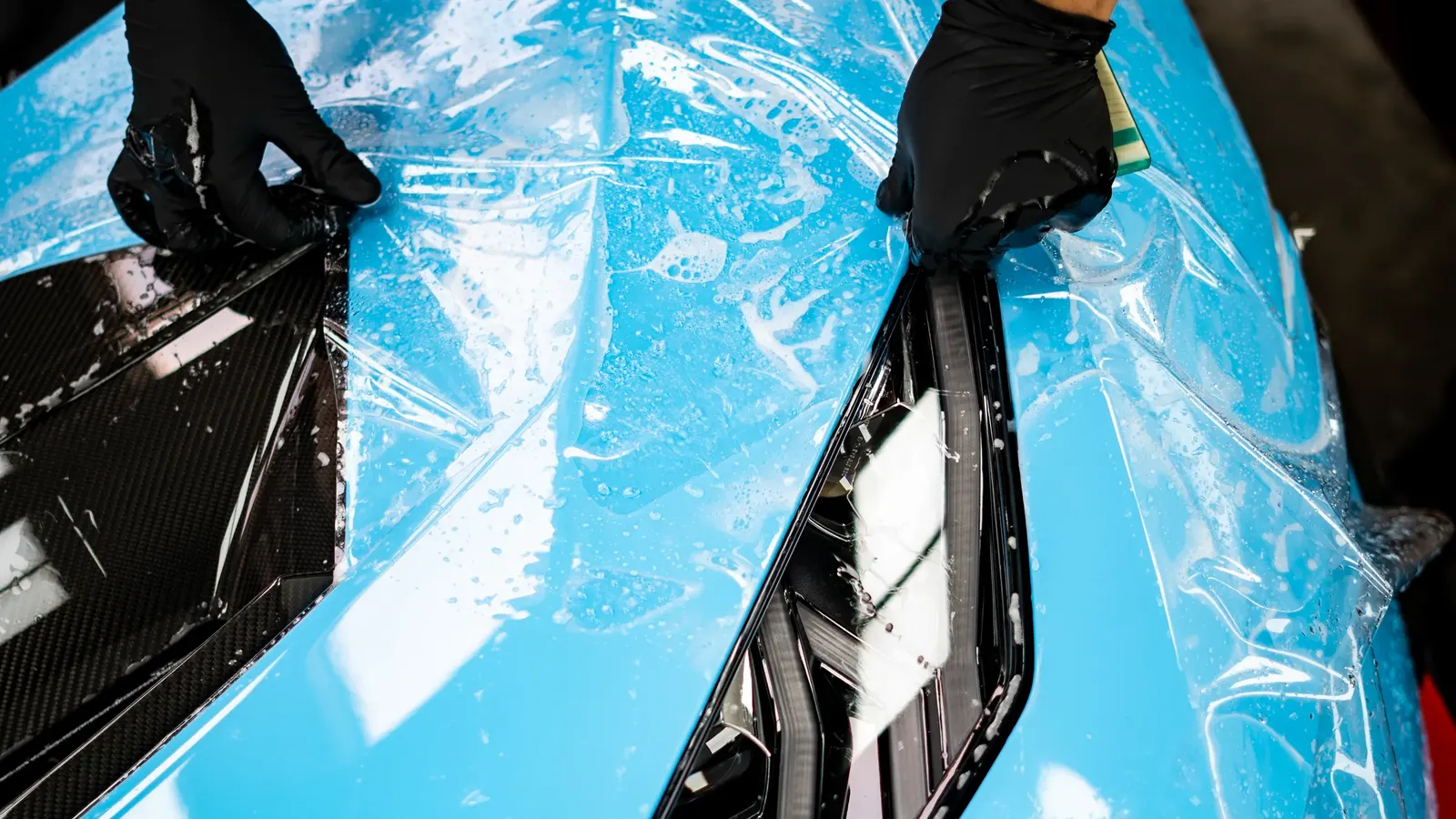
Only a layer that catches the stone instead of the paint stops new dots. That's what PPF film is for: a clear film we apply directly onto the paint. The stone hits the film, and the paint underneath stays as it was.
Ceramic protection can't do this. It protects paint from chemicals, salt and sun, not from flying stones. But it can sit on top of the film as well as on the rest of the car, as described on the Combining protections page.
Film doesn't repair dots already on the paint, it holds them as they are underneath it. That's why the paint is prepared before application — polishing and chip repair both have to happen before the film goes on the car. What film actually does and doesn't do is covered in more detail in the article What PPF film really does — and doesn't.
How much of the front to protect
- The spots stones hit first: headlights and the front part of the bonnet.
- The whole front of the car: film on the front of the vehicle, usually up to the A-pillar, meaning the pillar next to the windscreen. For a car that covers a lot of motorway kilometres. Paint correction is priced separately, based on the inspection.
- Just the headlights: we can apply film to these alone too, as film on a single panel.
Clear FlexiShield films differ by manufacturer warranty (8, 10 or 12 years) and thickness (191, 203 or 216 µm), and the matte finish carries a 7-year manufacturer's warranty; the base is an 8-year warranty and 191 µm thickness, and the rest costs extra. Which PPF films we fit describes the films we fit. On the front, what mainly determines paint protection is film thickness: the thicker it is, the harder it is for a stone to punch through. You don't need to choose the warranty or thickness yourself. We'll recommend them based on how much motorway driving you do and how long you plan to keep the car.
What you're paying for
- Inspection and paint preparation. Whatever correction the paint needs, based on the inspection, is priced separately.
- Film in the type recommended for your car. How much is needed depends on the coverage and the size of the car.
- Application. Our films are applied by Lukáš Vyskočil and Sebastian Vyskočil. SEVEN Works is a certified studio and FlexiShield installer.
- Warranty on the work from us and manufacturer warranty on the film, plus warranty checks.
What the price depends on
Mostly on coverage: headlights and part of the bonnet is a different job from the whole front of the car. A large vehicle needs more material than a small one. Then on the chosen warranty, thickness and finish: a film with ceramic protection and a matte finish both cost more than the base clear film. And finally on the condition of the paint: how many chips need repairing and what correction the paint needs. We'll send an exact figure for your car and the chosen coverage.
What if something goes wrong
We give a two-year warranty on the work. For clear FlexiShield film, the manufacturer's warranty follows the length you choose: 8, 10 or 12 years; for the matte finish it is 7 years. We carry out warranty checks. If you notice anything about the film that doesn't seem right, write to us and we'll take a look. What's normal in the first few days after application is described in the article on bubbles under fresh PPF film. How to wash a car with film, you'll find in the article A car with PPF film: how to wash it.
Write to us about how you drive
You don't need to know the coverage, warranty or film thickness. Tell us what car you have, how much and where you drive, how long you want to keep it, and whether the front has already been repainted. A photo of the bonnet and bumper in side light helps. Prefer to call? We're at +420 739 374 074.
Topic: Film on the paint
More in this topic